Logistics runs on software. When the warehouse management system stops, so do the trucks. When the EDI gateway drops, carriers miss pickups. When the visibility platform goes dark, customers start calling.
Modern logistics operations depend on a tightly integrated IT stack that must stay online round-the-clock, across time zones, customers, and carriers. The internal IT teams at most logistics operators are too small to handle the full scope of what today’s technology environment demands.
Three forces are compounding at the same time. Cybersecurity pressure on transportation and industrial targets is rising sharply. Real-time visibility has become non-negotiable for enterprise shippers. AI is moving from narrow pilots into operational reality. For most logistics operators, managed IT services bridge the gap between what the business needs and what the internal team can sustain.
Key Takeaways
- Logistics IT runs continuously across dozens of partner integrations, making it one of the most demanding environments for managed services.
- Cybersecurity is the top logistics IT priority in 2026, driven by the sector's dual IT and OT attack surface.
- The managed services sector is growing at 13.6% compound annual rate through 2030, with logistics among the fastest-adopting verticals.
- 84% of enterprises cite cloud cost management as their top cloud challenge, making FinOps a core managed services capability.
- Mid-size 3PL operators that shift to a hybrid managed model typically reduce total IT operating cost by 18 to 25% in the first year.
Why Is Logistics IT Uniquely Demanding?
Logistics IT is uniquely demanding because operations run continuously across carriers, shippers, and regulators, and an hour of downtime cascades across the entire network.
Several characteristics make this environment harder to manage than most verticals:
- Operations run round-the-clock across multiple time zones, with no maintenance windows that don’t affect anyone
- Integrations are dense, spanning EDI, API, and file-based handoffs to hundreds of trading partners
- Assets are distributed across warehouses, ports, vehicles, and last-mile handhelds
- Margins are thin, so unplanned downtime is not absorbed but penalised through contract penalties and missed SLAs
What happens when the warehouse scanner goes down at 2 a.m. during peak? Inventory stops updating, picks pile up, and the morning shift starts the day behind. That is why logistics buyers evaluate IT operating models differently from those in most other verticals.
What Does the Technology Stack Look Like in Modern Logistics?
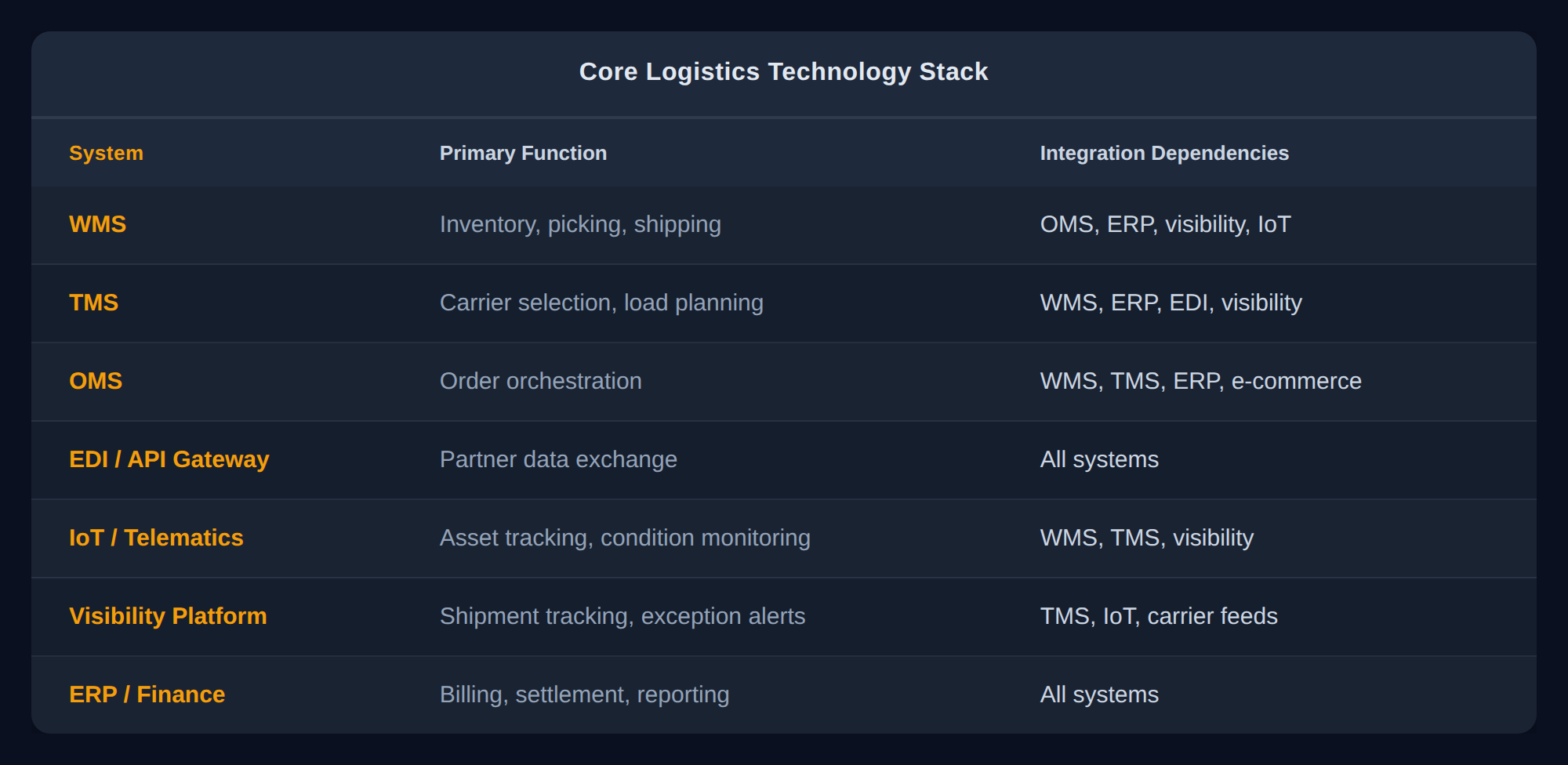
The typical mid-size to enterprise logistics operation runs on 8 to 12 tightly integrated systems. Each system depends on data from the others, and a failure in one often cascades across the chain.
The core stack typically includes:
- Warehouse Management System (WMS) for inventory control, pick/pack, and put-away operations
- Transportation Management System (TMS) for carrier selection, load planning, and freight audit
- Order Management System (OMS) for cross-channel order orchestration
- EDI or API gateway for partner data exchange with carriers, customs brokers, and customers
- Telematics and IoT sensors on fleet assets, yard equipment, and warehouse conveyors
- Real-time visibility platform for shipment tracking and exception management
- ERP and finance systems at the back end for billing, settlement, and reporting
Real-time visibility has moved from optional to standard among enterprise shippers. Every platform in the stack must feed the visibility layer accurately, which creates a continuous data quality problem that most internal teams struggle to manage at scale.
How Do Managed IT Services Support Logistics Operations?
Managed IT services support logistics by providing the infrastructure depth, specialised security, and continuous coverage that most internal IT teams cannot sustain across a full-stack logistics environment.
The managed services sector is growing at 13.6% compound annual rate through 2030, and logistics is one of the fastest-adopting verticals. The reason is straightforward: a full-stack logistics IT environment demands depth of capability that most internal teams cannot fund or staff.
Managed IT services typically support logistics operations across five areas:
- Infrastructure uptime and monitoring. Continuous NOC coverage across data centre, cloud, and edge infrastructure: proactive alerting, patching, and capacity management.
- Cybersecurity and ransomware defence. Managed SIEM, XDR, and SOC services. Incident response retainers. Vulnerability management across IT and OT assets.
- Cloud infrastructure and FinOps. Multi-cloud orchestration, cost governance, and observability across cloud workloads.
- EDI, API, and integration management. Partner onboarding, integration monitoring, and middleware operations so data keeps flowing between trading partners.
- Endpoint and IoT device management. Centralised management of handhelds, scanners, sensors, and fleet telematics across distributed sites.
The shift is from fragmented tool ownership to integrated platform operations. That changes how contracts are scoped, how KPIs are set, and how the business measures value.
Why Is Cybersecurity the Top Logistics IT Priority in 2026?
Cybersecurity is the top logistics IT priority in 2026 because the sector’s always-on operations, distributed OT assets, and dense partner ecosystems create an attack surface that ransomware operators have learned to exploit aggressively.
Ransomware activity targeting industrial and transport organisations surged by more than 87% year on year in 2024, with transportation consistently ranking as the second-most-targeted industrial sector, behind manufacturing. The pressure has continued to increase through 2025 and into 2026.
Several factors make logistics a prime target:
- Always-on operations mean downtime translates directly into stalled freight and contract penalties, which raises ransom-pay likelihood
- Partner ecosystems expand the attack surface through weak links in the EDI and API chain
- IoT and OT endpoints (scanners, yard sensors, fleet telematics, conveyor controllers) are often poorly patched
- ICS systems on warehouse floors were rarely designed with security in mind
Dual risk surface: Logistics operations face a risk profile that most other industries do not share: simultaneous IT and OT compromise. A ransomware attack can take down the WMS (IT side) and simultaneously halt conveyor lines and automated storage systems (OT side). Most internal security teams are funded for one domain, not both. Managed security providers with OT capability absorb the gap, and that gap is where modern attacks concentrate.
Managed cybersecurity in logistics typically bundles continuous SOC monitoring, XDR across endpoints and servers, OT network segmentation, identity-first access controls, and tested incident response plans.
How Are Cloud and Visibility Workloads Managed in Logistics?
Cloud and visibility workloads in logistics are managed through multi-cloud orchestration, continuous FinOps, and purpose-built observability that account for the high event volume and low-latency tolerance of shipment-tracking pipelines.
Hybrid cloud adoption now exceeds 70% of enterprises, and logistics is no exception. Modern WMS and TMS platforms are increasingly cloud-first, visibility platforms ingest event streams from carriers and IoT devices, and analytics workloads sit in cloud data lakes.
84% of organisations cite managing cloud spend as their top cloud challenge, surpassing security as the leading concern for the fourth consecutive year. Without active governance, logistics cloud costs drift above plan steadily as event volume grows and new integrations come online. The same research shows organisations exceed their cloud budgets by 17% on average, with 27% of total cloud spend classified as waste.
For logistics specifically, the visibility workload deserves special attention. Event volume is high, latency matters, and partner data feeds vary in quality. Managed services teams with logistics experience to tune the pipeline for accuracy and cost simultaneously.
How Does In-House IT Compare to Managed IT for Logistics?
Internal IT teams at most logistics operators are structurally under-resourced for the full scope of modern operations. The gap is most visible in cybersecurity, round-the-clock coverage, and peak-season scalability.
Capability comparison
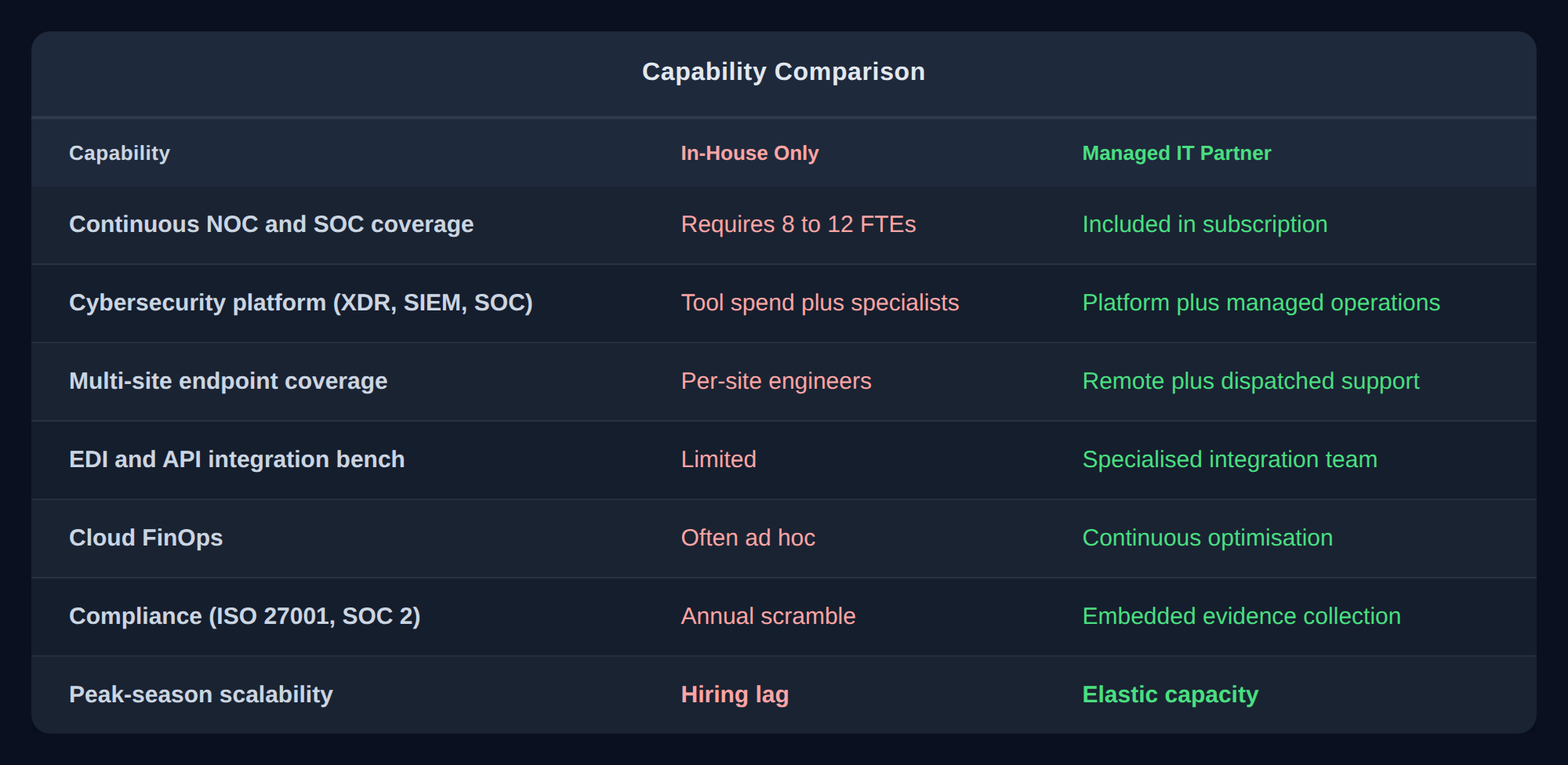
Our finding: Across mid-size 3PL engagements in 2025 and 2026, organisations that move from fully in-house IT to a hybrid managed model typically cut total IT operating cost by 18 to 25% in the first year. Most of the savings come from SOC consolidation and cloud optimisation. Teams that keep everything in-house usually underspend on security until an incident forces the rebuild.
The takeaway is not “outsource everything.” Internal IT should own business-aligned outcomes, while managed partners deliver the operational depth and specialisation needed to achieve them.
What Does AI Change for Logistics Operations?
AI transforms logistics operations by enabling demand forecasting, route optimization, warehouse automation, predictive maintenance, and anomaly detection with a precision that manual processes cannot match. The use cases are well-understood. The operating model underneath them is less so.
AI in logistics needs data pipelines that stay clean, models that stay tuned, GPU capacity that stays cost-efficient, and governance that stays auditable. None of that runs itself. Managed services teams are incorporating MLOps, model monitoring, and feature store operations into the standard scope for 2026 engagements.
AI readiness requirements for logistics
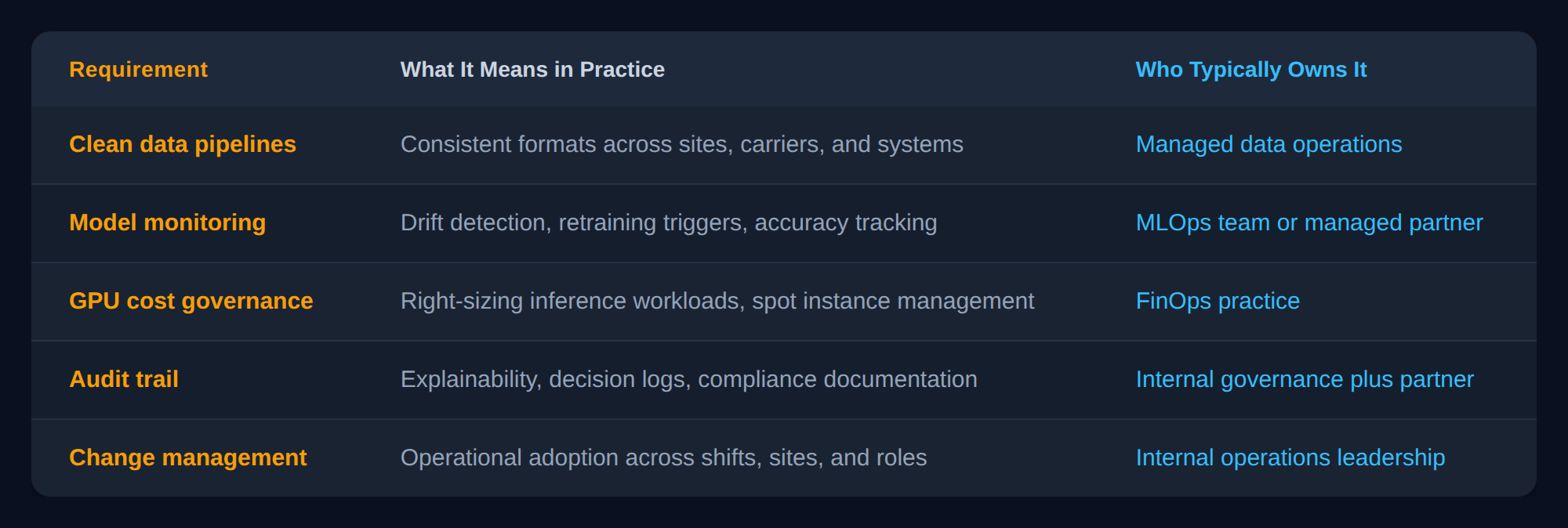
Our finding: Logistics AI pilots tend to succeed within 90 days on narrow use cases (one route network, one warehouse, one customer lane), then stall when the business tries to scale across operations. The usual blocker is not the model. It is the data pipeline, the feature consistency across sites, and the change management across operations teams. Organisations that sequence AI rollout alongside managed data operations tend to scale roughly twice as fast as those treating AI as a separate project.
Is the AI roadmap supported by an operating model that can sustain it at scale? That question matters more than model selection.
How Should Logistics Operators Evaluate a Managed IT Partner?
Logistics operators should evaluate managed IT partners on capability depth in areas that matter for supply chain operations, not on generic service catalogue breadth.
Six criteria separate logistics-capable partners from generic ones:
- Industry references. Active clients in 3PL, freight forwarding, warehousing, or last-mile. Ask for operational references, not case study summaries.
- Time-zone coverage. Continuous coverage that matches the operational footprint, not just business hours.
- Cybersecurity maturity. Named SOC, incident response retainer, OT security capability, and a track record in transport or industrial sectors.
- Integration expertise. EDI, API, iPaaS, and middleware operations. Ask specifically about partner onboarding time and integration monitoring.
- Cloud and FinOps depth. Multi-cloud experience, named FinOps practice, and cost optimisation track record with measurable outcomes.
Compliance posture. ISO 27001 certified, SOC 2 Type II, NIST CSF alignment, and experience supporting customer audits.
Frequently Asked Questions
How does managed IT reduce integration failures across logistics partners?
Integration failures between trading partners are one of the most common sources of operational disruption in logistics. Managed IT providers maintain dedicated integration teams that monitor EDI, API, and middleware connections continuously, catching failures before they cascade into missed pickups or invoice mismatches. Partner onboarding, format mapping, and exception handling become repeatable processes rather than ad-hoc firefighting.
What should a logistics company prioritise first when engaging a managed IT partner?
Cybersecurity and cloud governance should be the first two priorities. The ransomware threat to transportation and warehouse operations is immediate and well-documented. Cloud governance addresses the cost drift that compounds month over month without active management. Once these two foundations are stable, the engagement can expand into integrations, endpoint management, and AI operations.
Can managed IT services support legacy WMS or TMS systems?
Yes. Effective managed IT providers wrap legacy systems with modern operations rather than forcing an immediate replacement. Integration layers, monitoring, security, and cloud hosting can all be added without ripping out the core platform. That allows logistics operators to modernise at their own pace while keeping current operations stable and auditable.
How do managed services handle peak-season scaling in logistics?
Peak seasons (holiday shipping, agricultural cycles, and promotional surges) demand elastic IT capacity that fixed internal teams struggle to provide on short notice. Managed partners pre-provision monitoring, endpoint coverage, and cloud capacity ahead of peak windows based on historical volume patterns. SOC coverage scales with event volume, and integration support expands to handle the surge in partner onboarding and EDI transaction load.
What compliance frameworks should a logistics MSP support?
At minimum, a logistics-focused MSP should hold ISO 27001 certification and SOC 2 Type II attestation. NIST CSF alignment demonstrates structured cybersecurity maturity. For logistics operators serving regulated verticals (pharmaceuticals, food, defence), the MSP should also support customer-facing audits and provide continuous evidence collection rather than annual scrambles.
Conclusion
Logistics operations run on increasingly complex, always-on technology. The sector’s IT challenges, spanning cybersecurity pressure, visibility demands, cloud complexity, and AI adoption, are too broad for most internal teams to handle alone.
Managed IT services offer the depth, round-the-clock coverage, and specialised capability that modern logistics needs without the hiring lag or tooling sprawl. The model is not about outsourcing everything. It is about pairing internal business knowledge with external operational depth.
Evaluate managed IT partners on their logistics experience, cybersecurity maturity, integration depth, and cloud and compliance posture. The right partner becomes an operational backbone. The wrong one becomes another vendor to manage.