Future of Managed IT Services: 7 Trends to Watch in 2026
Managed IT services are entering a structural transition that reshapes how providers and buyers define value. The reactive monitoring, break-fix support, and vendor consolidation that defined the model through 2022 no longer cover what enterprises need from a modern managed services partner.
Three forces are driving the change in parallel. Artificial intelligence has reached production maturity. Cloud economics demand continuous governance rather than quarterly reviews. Regulatory complexity is outpacing internal compliance capacity.
The seven trends shaping managed IT services through 2026 reflect how providers, technology platforms, and buyer expectations are converging on a new operating model.
Key Takeaways
- Managed services are shifting from cost-reduction tactic to strategic backbone, with 99% of senior leaders now viewing them as strategic.
- AI agents will autonomously make 15% of day-to-day work decisions by 2028, embedding agentic AI into core MSP delivery.
- 75% of organisations are consolidating security vendors as platform-led security replaces tool sprawl.
- 84% of enterprises cite cloud cost management as their top cloud challenge, making FinOps a default MSP capability.
- Worldwide IT spending will exceed USD 6.08 trillion in 2026, with managed services among the fastest-growing segments.
Trend 1: Agentic AI and AIOps Move From Pilot to Production
Agentic AI is shifting managed IT services from reactive ticket handling to proactive, AI-orchestrated operations where autonomous agents triage, remediate, and escalate within defined guardrails.
AI agents will autonomously make 15% of day-to-day work decisions by 2028, up from zero in 2024. For MSPs, this is not a distant forecast. It is the foundation of the next service delivery model.
The broader market context reinforces the urgency. The global AIOps market reached USD 27.6 billion in 2024 and is projected to grow to USD 120.19 billion by 2033 at a compound annual rate of 17.8%. Autonomous incident resolution, predictive failure detection, and self-healing infrastructure are moving from proofs-of-concept into standard service delivery.
The change reshapes engineer roles. Teams stop chasing alerts and start supervising agents that triage, remediate, and escalate on their own. Mean-time-to-resolution typically improves measurably once AIOps reaches operational maturity.
Our finding: In 2025 and 2026 mid-market engagements, AIOps pilots deliver quick wins on monitoring consolidation within 90 days. The bigger value, autonomous remediation, shows up between months six and twelve. Organisations that try to jump straight to autonomy without the consolidation step tend to stall. The sequencing matters more than the platform choice.
Agentic AI takes this further. Instead of rule-based automation, agents reason over tickets, logs, configuration state, and historical patterns. They take action within defined guardrails set by both the MSP and the client.
For buyers in 2026, the evaluation question is no longer “do you use AI?” The relevant question is what decisions the agents make autonomously, and what the governance model looks like.
Trend 2: Platform-Led Cybersecurity Replaces Tool Sprawl
Platform-led cybersecurity is replacing tool sprawl because fragmented security stacks create fragmented visibility, and fragmented visibility is what attackers exploit.
75% of organisations are pursuing security vendor consolidation, up from 29% in 2020. The consolidation is not cost-driven. It is signal-driven, with security and risk leaders citing operational inefficiency and lack of integration as the primary motivators.
The financial stakes reinforce the shift. The average global cost of a data breach reached USD 4.44 million in 2025, with the gap between breached and non-breached organisations correlating more with security architecture maturity than with budget size.
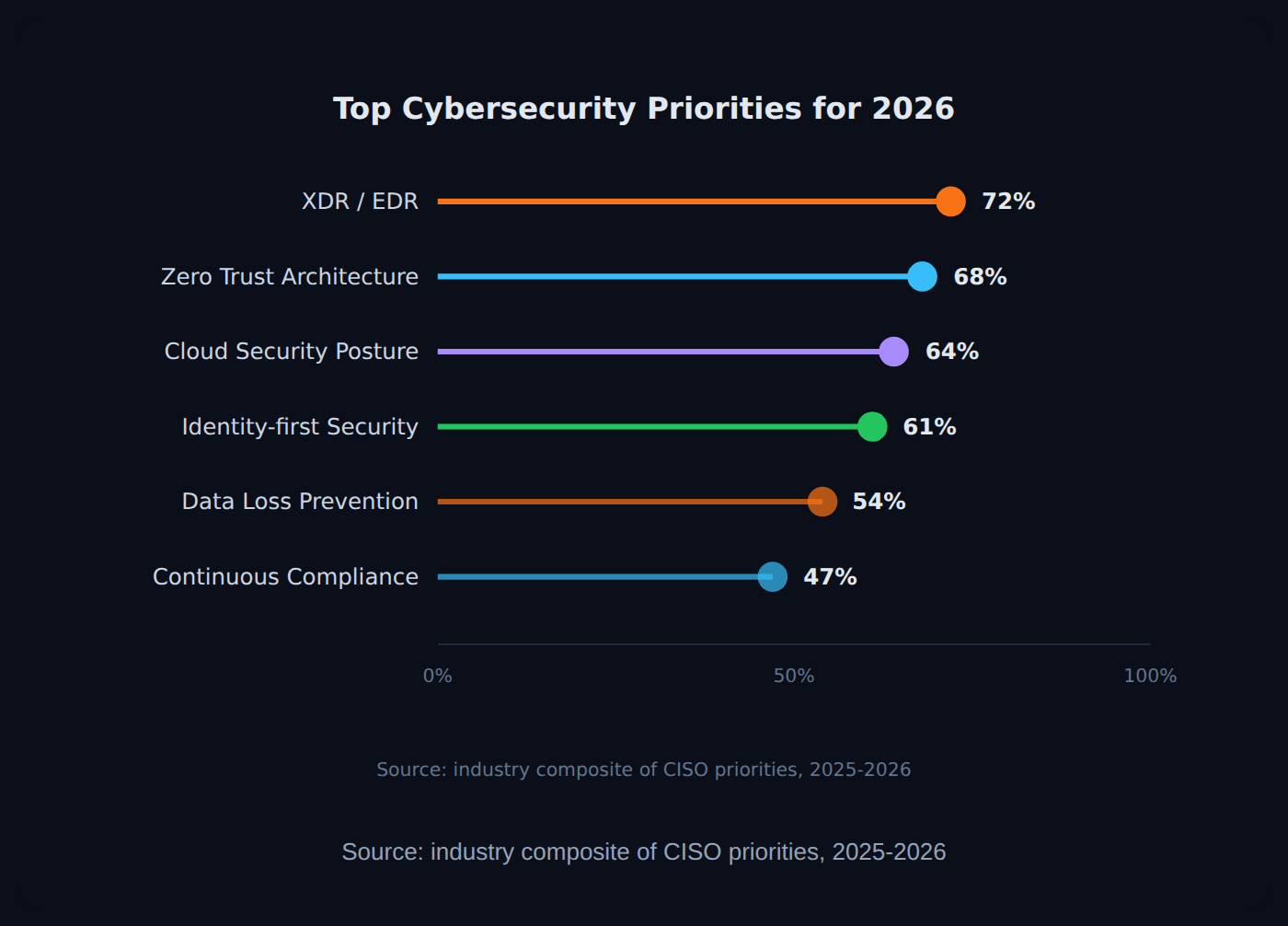
The architectural pattern is consistent across mature managed security engagements. MSSPs are moving away from standalone SIEM reselling. Modern delivery brings four capabilities under one operational umbrella: extended detection and response (XDR) for telemetry correlation, security orchestration and automated response (SOAR) for incident workflow, identity and access management for zero-trust enforcement, and cloud security posture management for hybrid environments.
Zero-trust architecture is becoming baseline rather than aspirational. Identity-first security has moved to the centre of the stack.
Hidden cost angle: Compliance cycles absorb more internal IT time than most organisations realise. ISO 27001 renewals, SOC 2 audits, GDPR refreshes, NIST CSF mappings, and PCI DSS recertifications quietly add 15 to 25% to internal IT operating costs through audit preparation, policy drift, and evidence gathering. Managed security providers absorb these cycles into subscription fees, creating a cost efficiency rarely quantified in trend analyses, and one that compounds every year regulations expand.
Trend 3: Multi-Cloud Orchestration Becomes a Core MSP Capability
Multi-cloud orchestration is becoming a core MSP capability because enterprises now run workloads across multiple providers and lack the internal bandwidth to coordinate placement, governance, and cost discipline continuously.
Hybrid cloud adoption now exceeds 70% of enterprises, with most organisations operating workloads across at least one public cloud, one private cloud, and often multiple public providers. Workload placement has become a multi-dimensional exercise in latency, data gravity, cost, and regulatory fit.
Few internal teams have the bandwidth to maintain this discipline continuously. MSPs are differentiating through four core competencies:
- Workload placement frameworks that quantify trade-offs between cost, performance, and compliance
- Cross-cloud networking that abstracts provider differences from application teams
- Unified observability that surfaces issues across all environments in one pane
- Cost governance that allocates and forecasts spend across providers in real time
Kubernetes and container orchestration are becoming standard offerings rather than premium add-ons. The buyer question is shifting from “can you run our cloud?” to “can you orchestrate across our clouds and optimise the whole?”
Trend 4: FinOps Becomes Standard Practice in Cloud Management
FinOps is becoming standard MSP practice because cloud spend has shifted from a manageable line item to a budget category that rivals payroll in scrutiny.
84% of organisations cite managing cloud spend as their top cloud challenge, surpassing security as the leading concern for the fourth consecutive year. The era when cloud was treated as a capex-to-opex rounding error is over.
27% of cloud spend continues to be wasted without active governance. The same research shows 60% of organisations now operate a dedicated FinOps function or have assigned cloud cost management to a named role.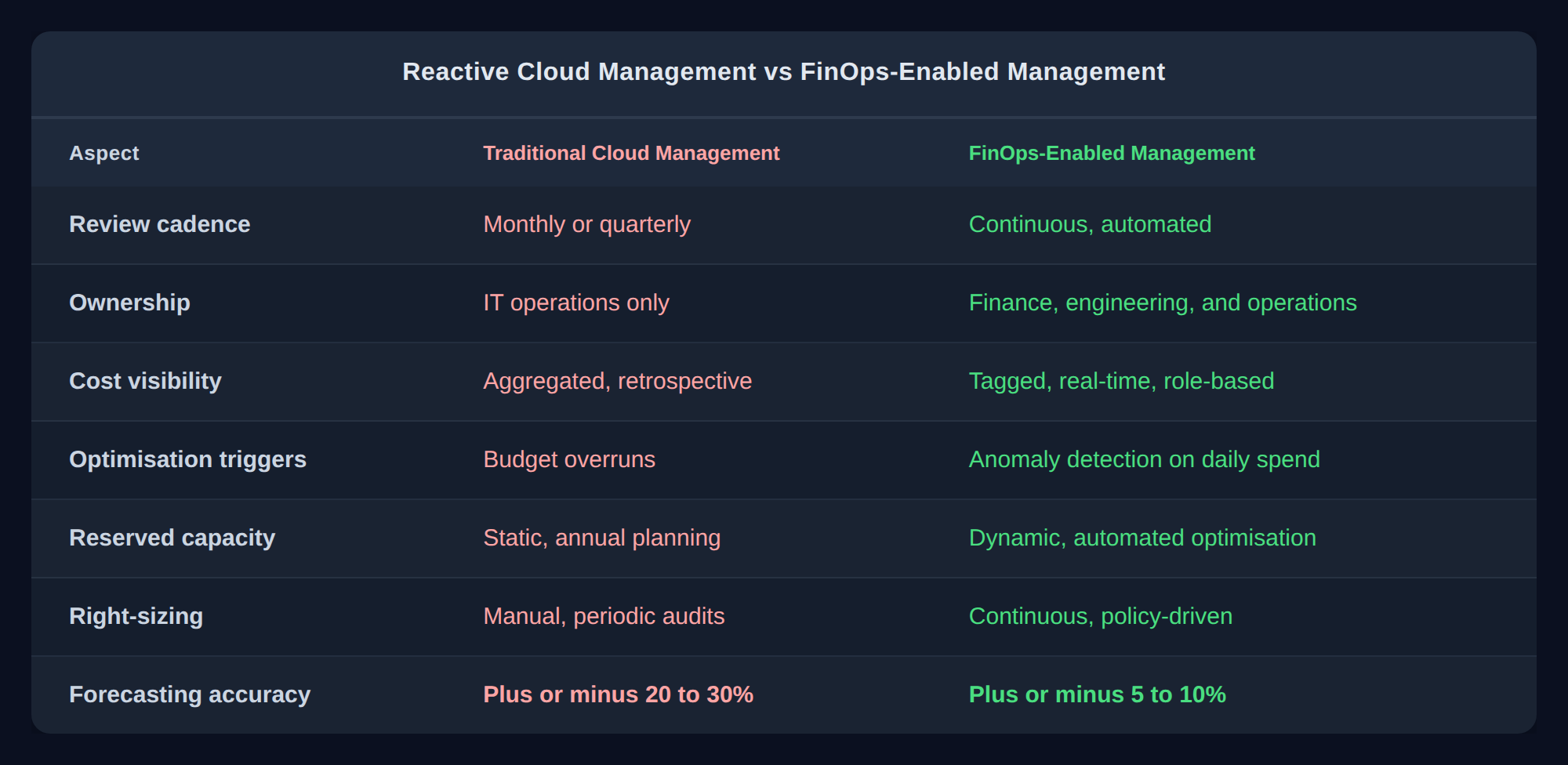
MSPs are embedding FinOps practices directly into service delivery rather than treating it as a separate consulting engagement. The fundamentals span tagging discipline and cost allocation, reserved capacity optimisation, right-sizing automation, anomaly detection on daily spend, and cross-functional governance between finance, engineering, and operations.
The shift is cultural as much as technical. Cloud cost management used to be quarterly. It is now continuous.
Trend 5: Hyperautomation Expands the MSP Scope
Hyperautomation is expanding the MSP scope from infrastructure management into business process orchestration, blurring the lines between IT operations, business operations, and digital transformation delivery.
Hyperautomation has become a staple discipline for 90% of large enterprises, with continuing investment driven by demand for operational excellence across processes and functions. The same research finds that 30% of enterprises will automate more than half of their network activities by 2026.
The scope of what an MSP delivers is expanding accordingly. Where MSPs used to stop at infrastructure, many now deliver business process automation alongside it. ERP integrations, workflow orchestration, RPA management, low-code platform support, and API management are becoming common line items in managed services agreements.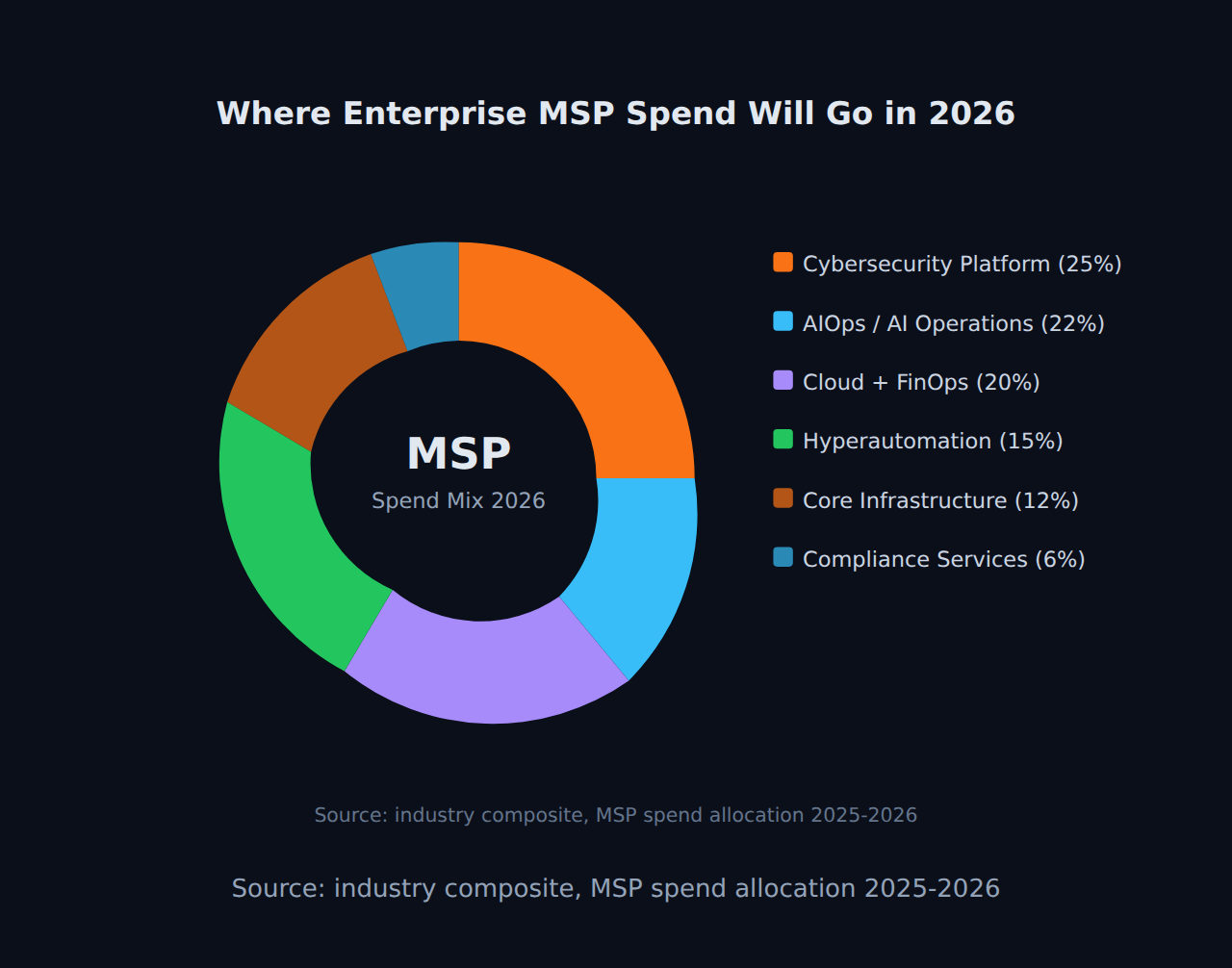
The shift in mindset is straightforward. The model is moving from “manage the infrastructure” to “manage the business outcome.” That reframing changes how contracts are scoped, how KPIs are defined, and how success is measured.
Trend 6: Compliance-Driven Delivery Models
Compliance-driven delivery is becoming the baseline because regulatory requirements are expanding faster than internal compliance teams can absorb them, and managed services with compliance built in reduce the recurring audit burden.
The global cybersecurity market is projected to grow from USD 264.43 billion in 2026 to USD 471.88 billion by 2031. A meaningful share of that growth is regulatory-driven rather than threat-driven.
Organisations now juggle ISO 27001, SOC 2, GDPR, NIST CSF, PCI DSS, and industry-specific mandates simultaneously. When regulations tighten, managed compliance becomes a higher-value offering than managed infrastructure alone.
MSPs are embedding three capabilities directly into delivery rather than offering them as premium add-ons:
- Continuous compliance monitoring against multiple frameworks in parallel
- Policy-as-code that enforces controls automatically across infrastructure changes
- Evidence automation that produces audit-ready documentation without manual effort
Audit-ready reporting is becoming a standard deliverable rather than a premium add-on. Compliance-native service design, where controls, logging, and data handling are engineered in from day one, is replacing after-the-fact remediation.
For buyers, the evaluation question is changing. It is no longer “can your MSP pass an audit?” The new question is “can your MSP make your audit boring?”
Trend 7: Strategic Partnership Replaces Vendor-Buyer Dynamics
Strategic partnership is replacing transactional vendor-buyer dynamics, with MSPs being evaluated alongside strategy consultancies rather than IT service providers, and contracts being structured around outcomes rather than hours.
99% of senior leaders surveyed in 2026 view managed services as strategic rather than tactical, with two-thirds expecting major impact within 24 months. That single shift captures the biggest transformation in the industry.
The change is visible in contract structure. Hours-based SLAs are giving way to outcome-based agreements where MSPs are paid for performance against business KPIs rather than time logged. Joint governance models, shared KPIs, and co-innovation frameworks are becoming standard in enterprise engagements. 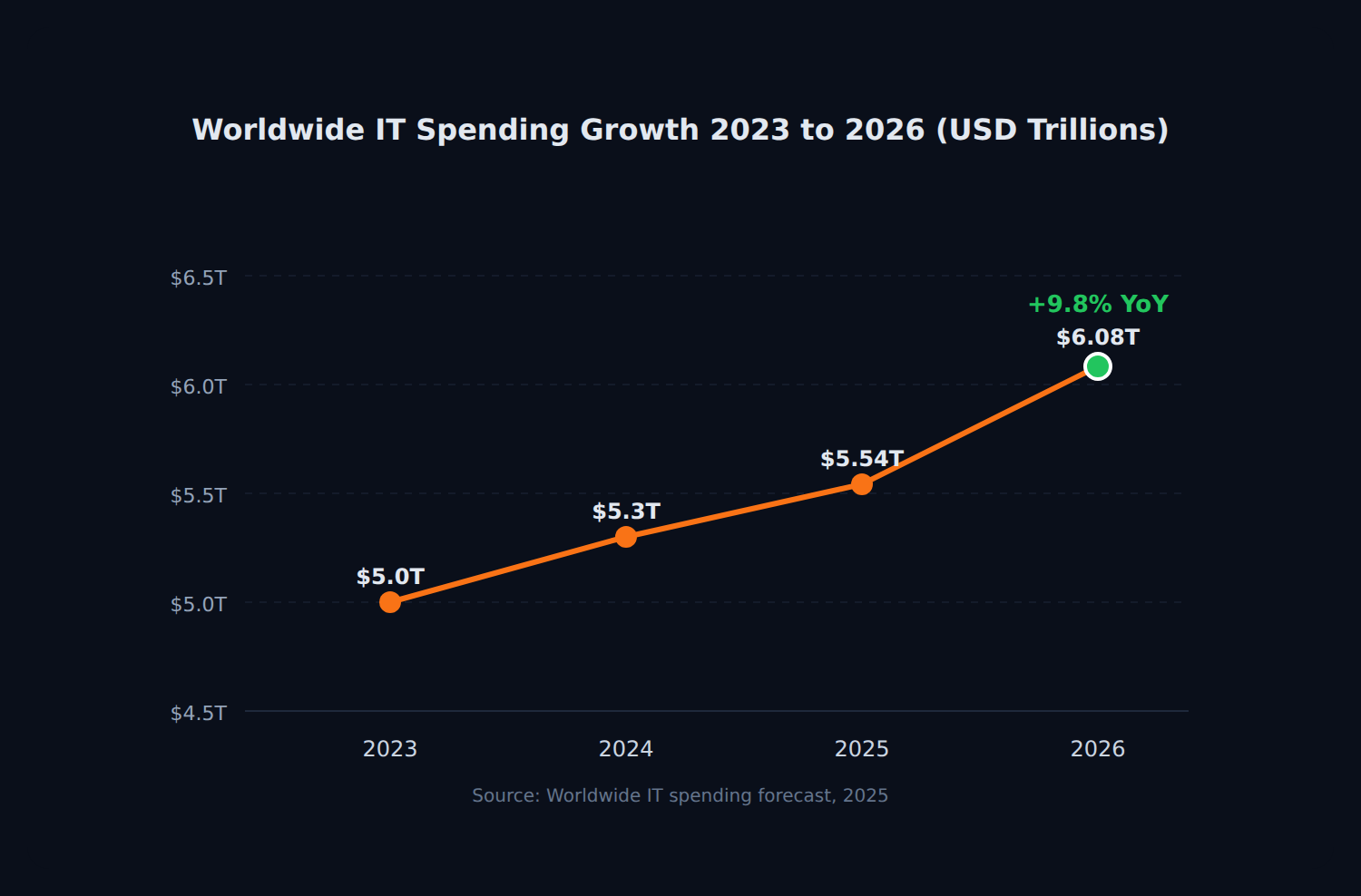 Worldwide IT spending will exceed USD 6.08 trillion in 2026, up 9.8% year on year. Managed services rank among the fastest-growing segments within that total because buyers increasingly want partners rather than suppliers.
Vendor relationship vs strategic partnership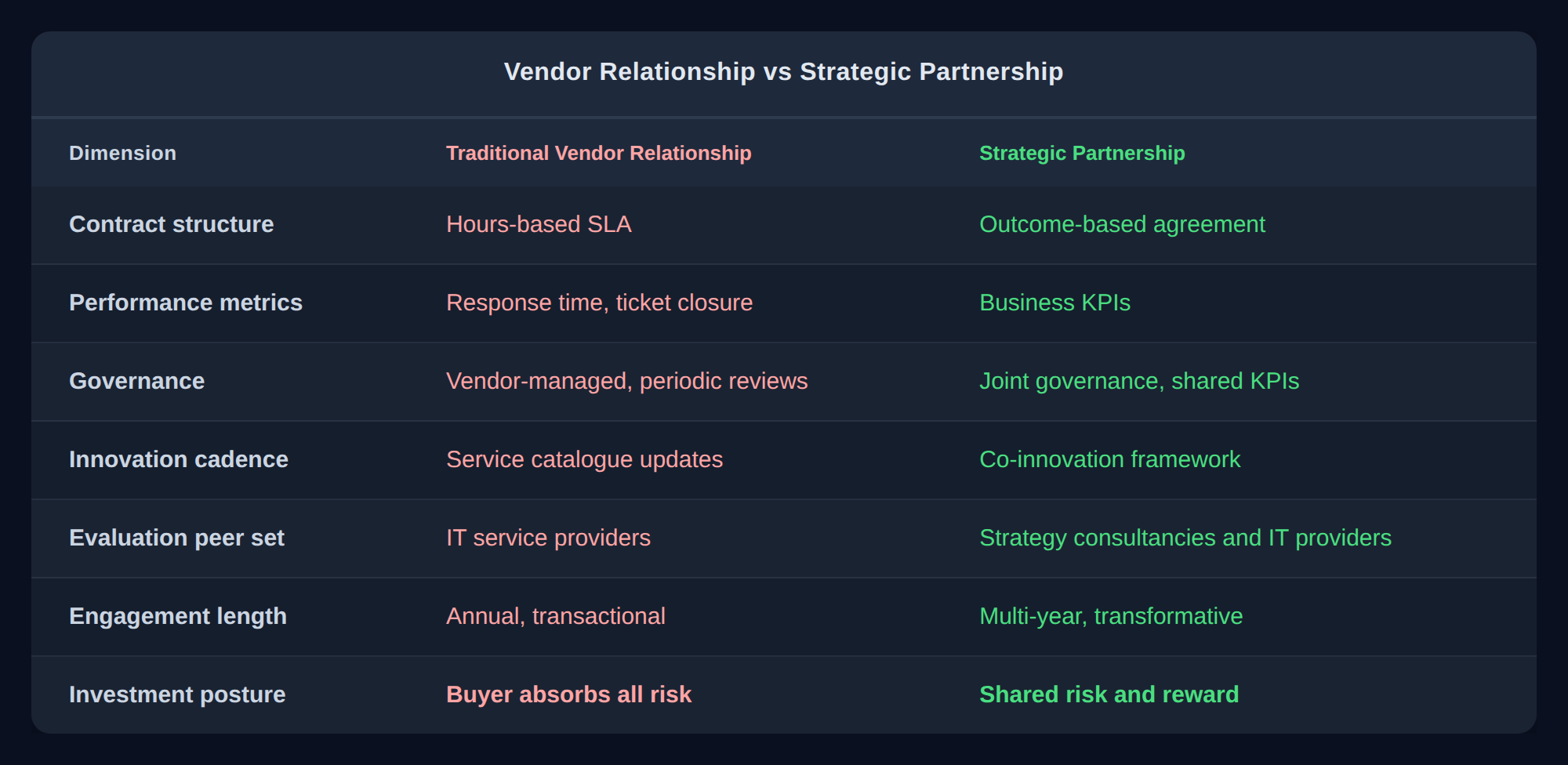
The distinction used to be semantic. In 2026, it is contractual.
Frequently Asked Questions
What is the biggest trend reshaping managed IT services in 2026?
Strategic partnership is the most consequential shift. The way enterprise buyers evaluate, contract with, and govern MSPs has moved from procurement-led purchasing to executive-level partnership. This change reframes every operational trend, including AIOps, FinOps, and platform security, as a partnership capability rather than a tool.
How will AI change managed IT services?
AI enables predictive monitoring, automated remediation, and self-healing infrastructure, allowing MSPs to shift from reactive ticket handling to proactive orchestration. The deeper change is governance. As agentic AI takes autonomous action within defined guardrails, the buyer evaluates the MSP on its agent governance model, audit trail, and decision rights framework, not just its monitoring stack.
What is FinOps and why does it matter for MSPs?
FinOps is the discipline of managing cloud spend through cross-functional collaboration between finance, engineering, and operations teams. With cloud now the largest line item in many IT budgets, MSPs are embedding FinOps directly into service delivery. The capability is becoming standard rather than premium, and providers without it lose access to enterprise renewals.
Will managed IT services replace in-house IT teams?
No. The pattern is augmentation rather than replacement. Internal teams increasingly focus on business-aligned strategy and product engineering, while MSPs handle operations, security, and platform delivery. The future is hybrid, with internal IT owning outcomes and MSPs delivering the capacity and specialisation needed to achieve them.
What should businesses prioritise when choosing a future-ready MSP?
Four capabilities matter most in 2026:
- Mature AIOps and agentic AI operations with documented governance
- Platform-led cybersecurity covering XDR, SOAR, identity, and cloud security
- Multi-cloud orchestration with embedded FinOps practices
- Compliance-native delivery aligned to ISO 27001, SOC 2, GDPR, NIST CSF, and PCI DSS
Evaluate MSPs on operational maturity in these four areas rather than on service catalogue breadth alone.
Conclusion
The managed services industry is being rebuilt around AI maturity, platform economics, and strategic partnership. Each of the seven trends covered above reinforces the others, and none can be addressed in isolation. Agentic AI without platform security creates governance gaps. Multi-cloud without FinOps creates uncontrolled spend. Hyperautomation without compliance creates audit exposure.
The organisations that plan for these shifts now will spend the next 24 months scaling capability. Those that wait will spend the same 24 months catching up to a baseline that has already moved.
Choosing an MSP in 2026 is no longer a procurement decision. It is a strategic one, with implications for how the IT operating model performs over the next three to five years.
Ready to evaluate what these trends mean for your IT operating model? Talk to an expert for a complimentary 2026 managed services readiness assessment.