
At enterprise scale, IT is not one system. It is dozens of integrated platforms running across geographies, business units, and regulatory regimes. The operating model has to absorb scale, complexity, and governance pressure simultaneously, while supporting active transformation on top.
Enterprise managed IT services differ from SMB or mid-market MSP work in four dimensions. The scale is larger, the governance is heavier, the specialisations are deeper, and the engagement model has shifted from staff augmentation to strategic partnership. The criteria for evaluating a partner at this scale have changed with it.
Key Takeaways
- 99% of senior leaders now view managed services as strategic, with two-thirds expecting major impact within 24 months.
- Enterprise engagements cover six capability areas: infrastructure, cybersecurity, cloud, compliance, application engineering, and AI operations.
- 75% of organisations are consolidating security vendors, up from 29% in 2020, driving platform-led security as the default.
- 84% of enterprises cite cloud cost management as their top cloud challenge, making FinOps a standard capability in enterprise MSP engagements.
- The dominant engagement model is shifting from traditional SLA contracts to outcome-based agreements tied to business KPIs.
What Defines Enterprise Managed IT Services?
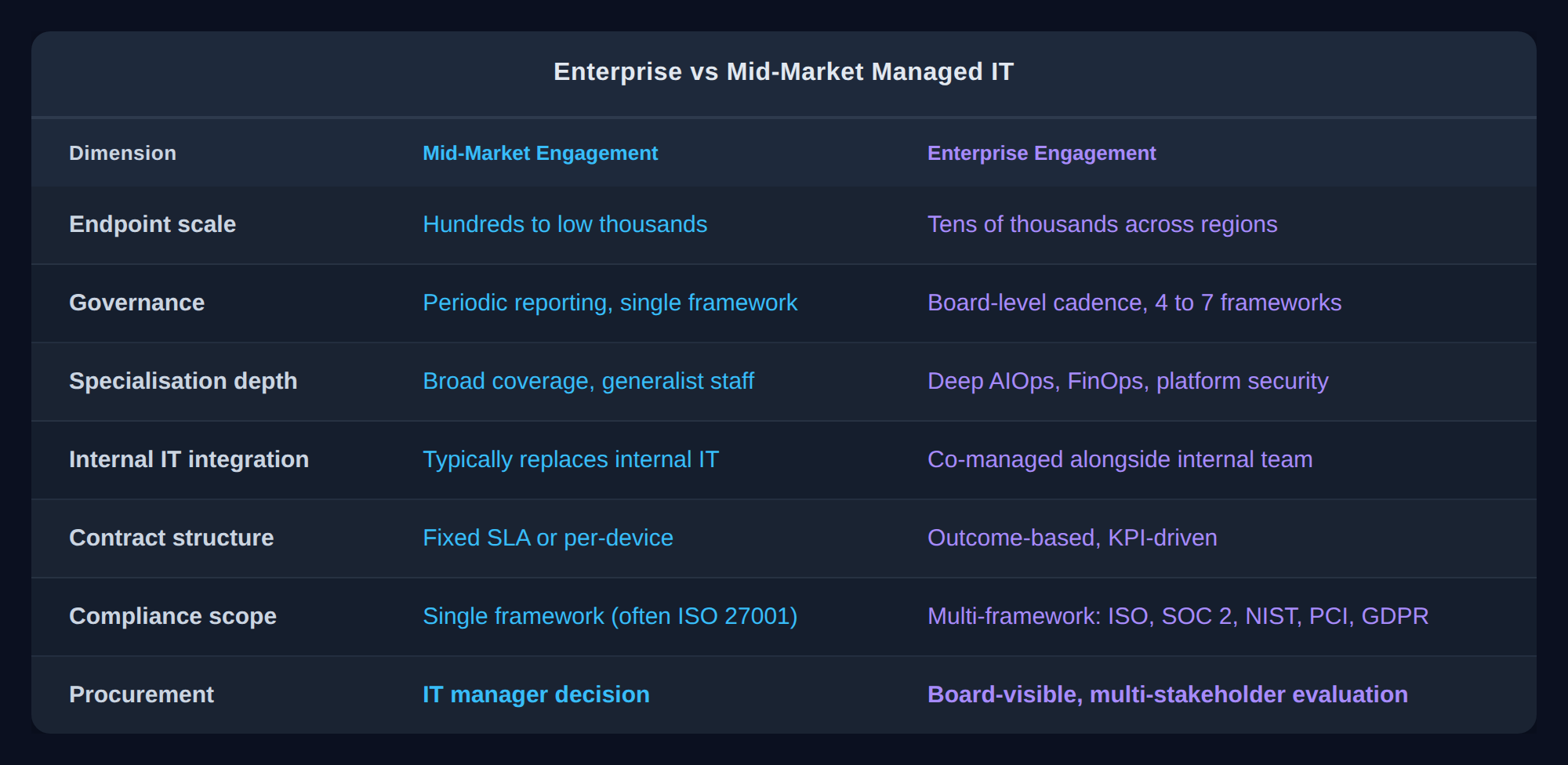
Enterprise managed IT services differ from SMB or mid-market engagements across four dimensions: scale, governance, specialisation, and integration with internal IT.
Scale comes first. Enterprise engagements cover tens of thousands of endpoints, multiple data centres, multi-region cloud footprints, and global user populations. A single engagement may span three continents and a dozen regulatory jurisdictions.
Governance follows closely. Board-level reporting, audit readiness across several compliance frameworks, and procurement processes that require transparent pricing and outcome accountability are standard expectations.
Specialisation is the third difference. Enterprises need deep capabilities in areas such as AIOps, FinOps, platform security, and compliance-as-code. Generalist IT support does not meet the bar. The fourth dimension is integration: most enterprise MSPs work alongside an internal IT team rather than replacing it, which demands different delivery and governance models than a full-outsource.
Why Are Enterprises Adopting Managed IT at Scale?
Enterprises are adopting managed IT at scale because the combination of talent scarcity, platform complexity, and board-level accountability has made the traditional internal-only model unsustainable for most large organisations.
99% of senior leaders now view managed services as strategic rather than tactical, with two-thirds expecting major impact within 24 months. That finding, drawn from 1,224 respondents, captures the single biggest shift in enterprise IT operating models.
Five forces are driving the change:
- Talent scarcity in specialist roles (SOC analysts, FinOps practitioners, AIOps engineers) has made internal hiring slow and expensive
- Cost structures are moving from capex to opex at pace, and boards want predictable technology spend
- Platform consolidation, especially in security, is simplifying vendor landscapes
- Cloud complexity continues to rise with multi-cloud, edge, and hybrid architectures
- Boards now want measurable outcomes rather than service ticket volumes
Can an internal IT team realistically staff continuous SOC coverage across three regions while also operating FinOps, AIOps, and compliance at depth? Few can. That is why enterprises now look to strategic IT partnership as the default operating model.
What Capabilities Does an Enterprise Managed IT Engagement Cover?
An enterprise managed IT engagement typically covers six capability areas that extend well beyond traditional IT support into full technology operations.
The scope has widened because enterprise buyers are consolidating vendors and demanding integrated delivery rather than point solutions. Each capability area has its own maturity curve, staffing model, and governance requirements.
- Infrastructure operations. Continuous NOC coverage, hybrid cloud and data centre operations, network and connectivity management, endpoint management across distributed sites.
- Cybersecurity platform. Round-the-clock SOC services, XDR and SIEM operations, SOAR automation, identity and access management, OT and cloud security posture management.
- Cloud operations and FinOps. Multi-cloud orchestration, cost governance, observability, and workload placement decisions across providers.
- Application and platform engineering. Platform reliability, container and Kubernetes operations, DevOps tooling, service mesh management.
- AIOps and automation. Intelligent alerting, predictive failure detection, autonomous remediation, and hyperautomation workflows.
Compliance and governance as a service. Policy-as-code, continuous compliance monitoring, evidence automation, and audit-ready reporting.
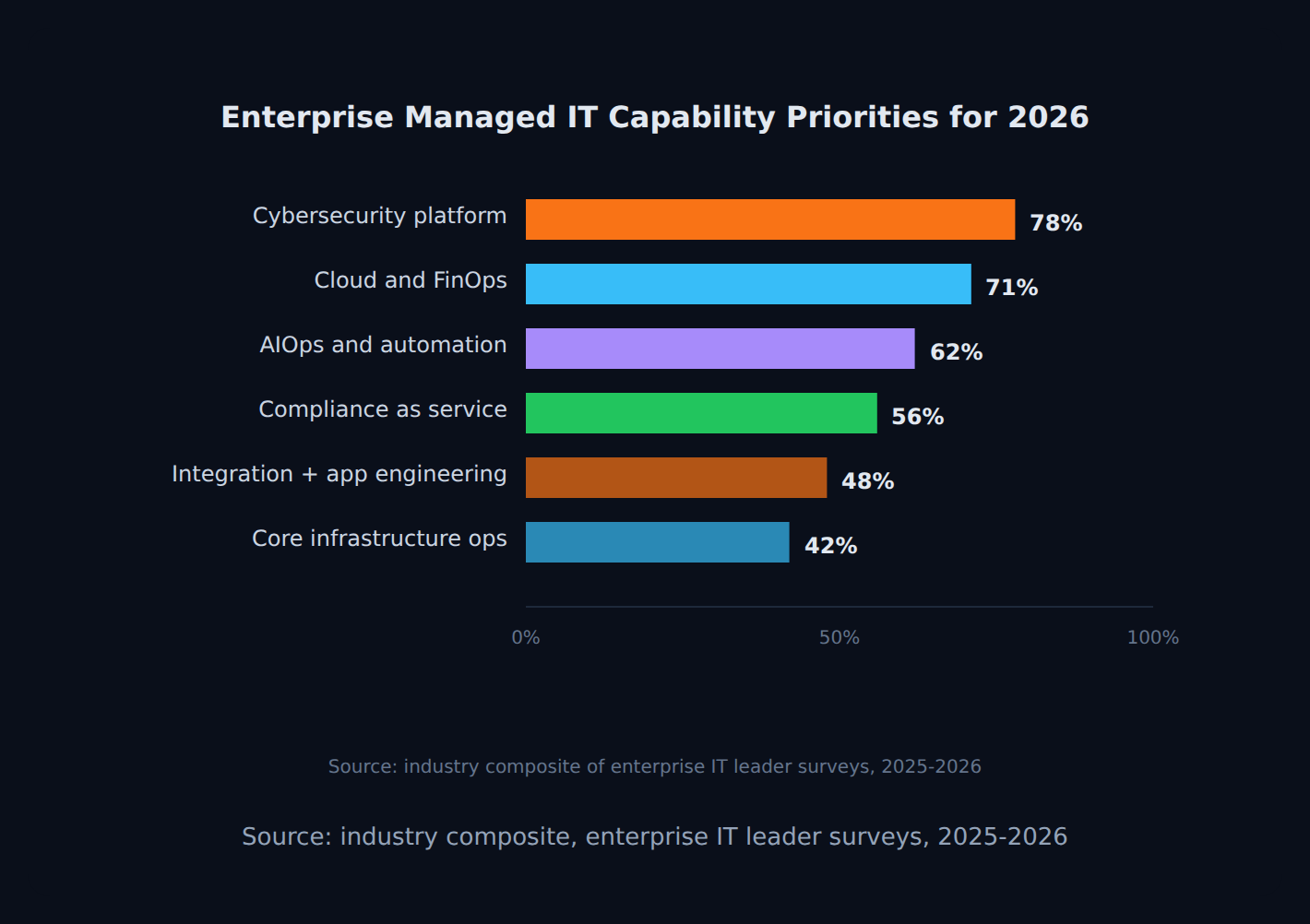
Most enterprise engagements now include an AIOps scope by default, with autonomous alerting and predictive failure detection as baseline expectations rather than premium add-ons.
How Does Cybersecurity Change at Enterprise Scale?
Cybersecurity at enterprise scale shifts from tool procurement to platform operations, where the challenge is not buying defences but orchestrating detection, response, and compliance across a global footprint.
75% of organisations are consolidating security vendors, up from 29% in 2020. The consolidation is not primarily cost-driven. Security and risk leaders cite operational inefficiency and a lack of integration as the primary drivers of moving to fewer, more deeply integrated platforms.
Enterprise SOC requirements differ substantially from those of the mid-market. Continuous coverage across time zones is table stakes. Threat hunting, incident response retainers, and red-team testing are standard. Identity-first security has moved to the centre of the stack, with zero-trust architecture becoming baseline rather than aspirational.
Hidden cost angle: Enterprise security budgets increasingly flow to managed platforms because in-house teams cannot absorb the 15-25% annual hidden cost of compliance cycles, framework renewals, and policy drift. Managed security providers bundle these cycles into subscription pricing, which lowers the total cost of compliance over a three-to-five-year horizon. That saving compounds each year as regulations expand, and it is rarely quantified in vendor materials.
How Do Cloud, Multi-Cloud, and FinOps Work at Enterprise Scale?
Cloud operations at enterprise scale centre on orchestration across providers rather than on selecting a single provider. Workload placement, data gravity, cross-cloud networking, and unified observability dominate the agenda in 2026.
Hybrid cloud adoption now exceeds 70% of enterprises, and most large organisations operate workloads across at least two public cloud providers alongside private infrastructure. The question is no longer “which cloud” but “how do we govern across all of them?”
84% of organisations cite managing cloud spend as their top cloud challenge, surpassing security as the leading concern for the fourth consecutive year. The same research shows organisations exceed their cloud budgets by 17% on average, with 27% of total cloud spend classified as waste.
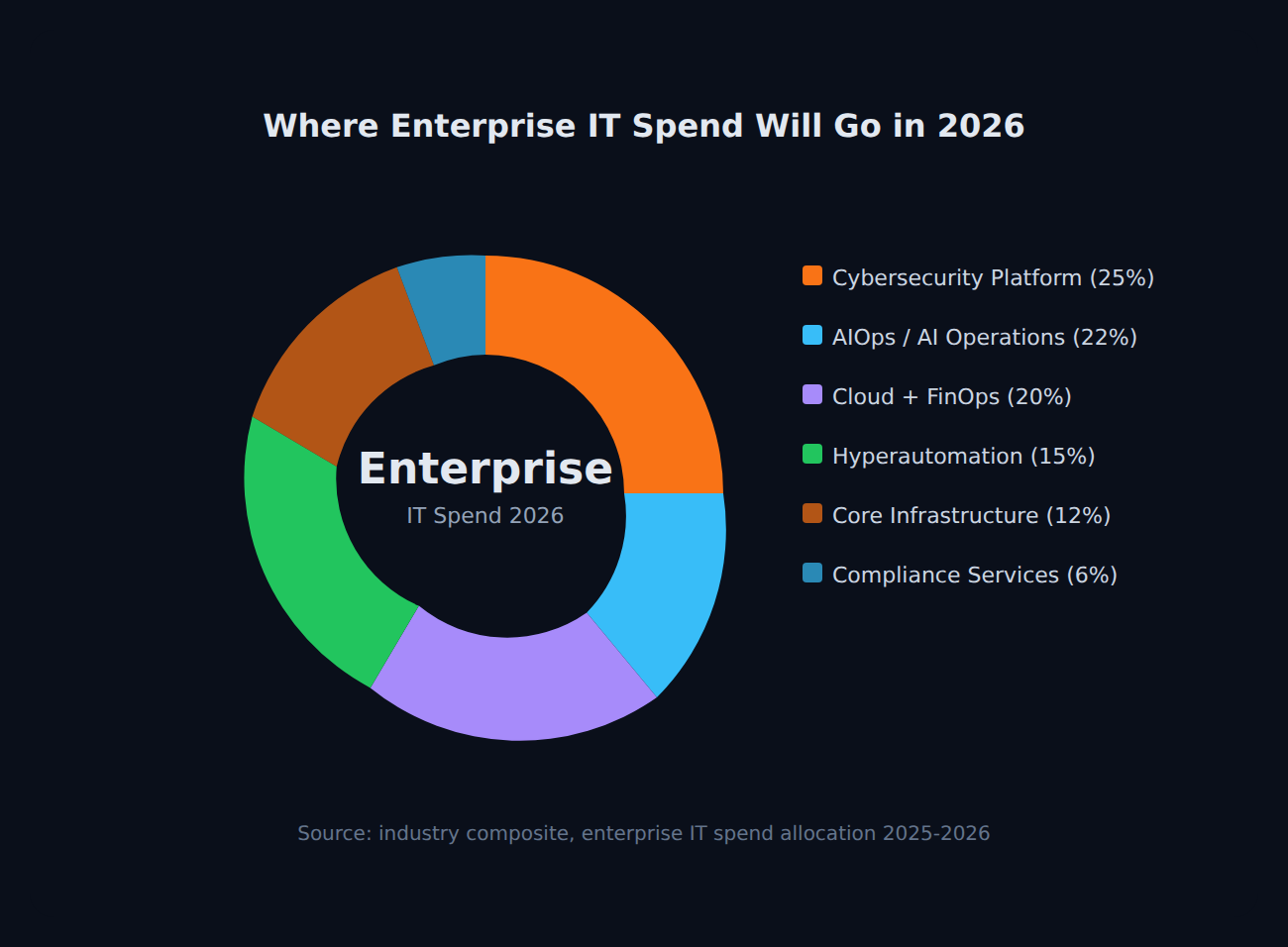
Enterprise managed services now embed FinOps directly into delivery rather than treating it as a separate consulting engagement. That shift changes how cloud cost accountability is distributed across finance, engineering, and operations. The FinOps practice becomes a shared function within the managed engagement, not a project layered on top.
What Do Governance, Compliance, and Reporting Look Like at Enterprise Scale?
Governance, compliance, and reporting at enterprise scale require continuous, multi-framework operations rather than annual audit cycles. The complexity is structural: most large organisations juggle four to seven compliance frameworks simultaneously.
The global cybersecurity market is projected to grow from USD 264.43 billion in 2026 to USD 471.88 billion by 2031, and a meaningful share of that growth is regulatory-driven rather than threat-driven. ISO 27001, SOC 2 Type II, NIST CSF, PCI DSS, GDPR, ISO 20000, ISO 22301, and industry-specific mandates each add operational overhead.
Enterprise-managed IT services now embed compliance into their delivery rather than bolt it on. That means policy-as-code, continuous compliance monitoring, automated evidence collection, and audit-ready reporting as standard deliverables. Board-level reporting cadence is typically monthly, with continuous dashboards accessible to risk, finance, and audit functions.
Our finding: Across enterprise engagements in 2025 and 2026, organisations running four or more compliance frameworks typically reduce audit preparation time by 50-60% within 2 years of moving to a compliance-native managed service model. Most of the savings come from automated evidence collection and shared controls across frameworks, not from reduced audit scope.
Which Engagement Models Do Enterprises Use?
Enterprises choose between four engagement structures depending on maturity, internal capacity, and transformation ambition. The right model depends on what the internal team wants to own versus what it wants to delegate.
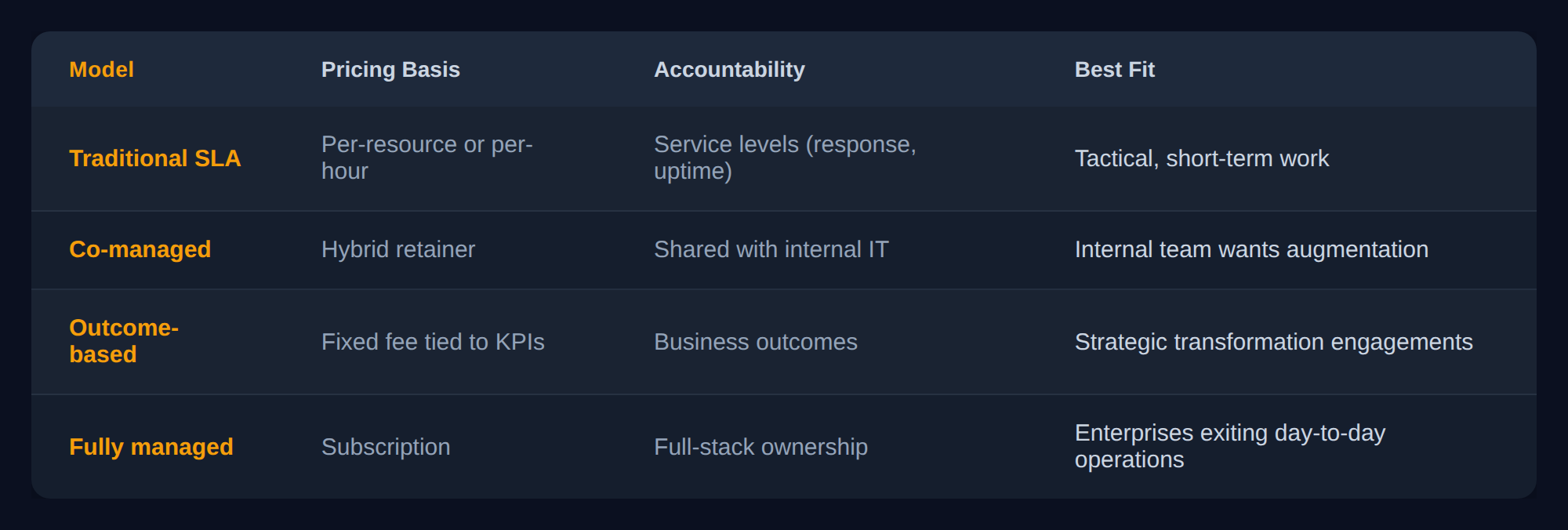
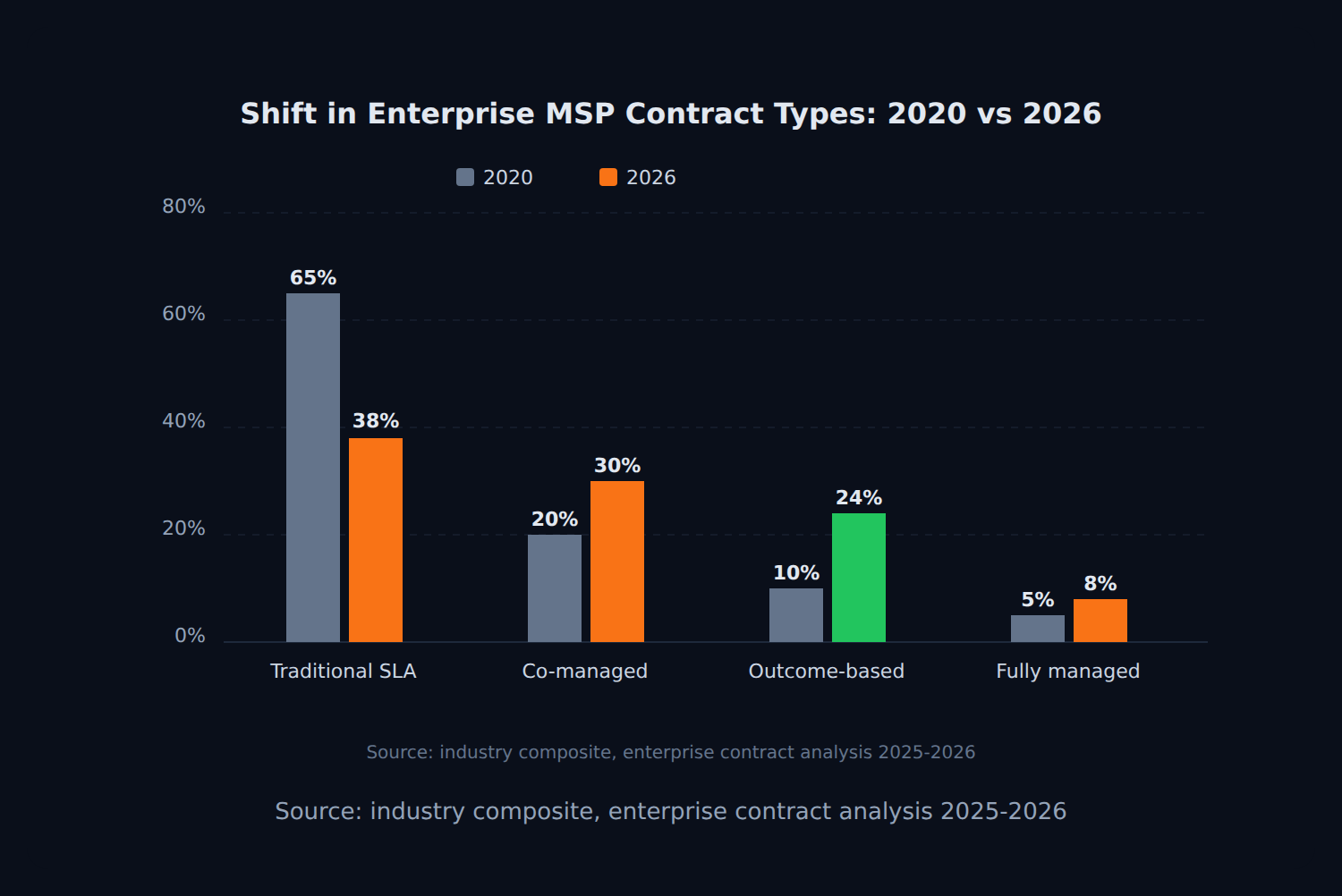
Our finding: Across enterprise engagements tracked in 2025 and 2026, there is a clear shift away from traditional SLA contracts. Roughly two-thirds of new enterprise deals now include at least one KPI-based outcome clause, with mean time to resolution, security incident volume, and cloud cost variance as the three most common KPIs. That pattern reflects a shift in procurement maturity as much as a delivery-side one.
Co-managed models are also rising. Enterprises want to keep strategic control of their IT agenda while delegating continuous operations to a partner. The question is no longer “outsource or not?” It is “which slice, which model, and which KPIs?”
How Do Enterprises Evaluate a Managed IT Partner?
Enterprise evaluation goes beyond service catalogue comparison to cover operating model, governance fit, and cultural alignment. The MSPs delivering at enterprise scale need demonstrable capability across seven dimensions.
- Scale of operations: concurrent enterprise clients, global footprint, and delivery capacity. Ask for operational references, not case study summaries.
- Security posture of the MSP itself. ISO 27001, SOC 2 Type II, penetration testing regime, and breach-notification SLAs.
- AIOps and automation maturity. Named platforms, automation coverage metrics, and a governance model for autonomous actions.
- Cloud and FinOps depth. Multi-cloud certifications, FinOps Foundation membership, and measurable cost optimisation outcomes.
- Integration model with internal IT. Proven co-managed capability, defined handoff protocols, and joint governance structures.
- Transparent reporting. Board-ready dashboards, monthly governance cadence, and a published service-management framework.
Peer enterprise references. Financial and operational references from similar-scale organisations, ideally in the same industry vertical.
Frequently Asked Questions
What is the difference between enterprise-managed IT and traditional IT outsourcing?
Traditional IT outsourcing replaces internal staff with external labour, typically priced per hour or per resource. Enterprise managed IT services go further by delivering integrated platform operations, where the provider owns outcomes across infrastructure, security, cloud, and compliance rather than just supplying headcount. The engagement model, governance structure, and accountability differ fundamentally.
How do outcome-based contracts work in enterprise-managed IT?
Outcome-based contracts tie MSP fees to measurable business KPIs rather than staff hours or service tickets. Common KPIs include mean time to resolution, security incident volume, cloud cost variance, and uptime for business-critical services. This model aligns provider incentives with enterprise outcomes and now appears in roughly two-thirds of new 2025 and 2026 enterprise deals.
Can enterprise managed IT work alongside an existing internal IT team?
Yes, and this is now the dominant pattern. Co-managed models let internal IT focus on strategic work, vendor relationships, and business alignment, while the managed partner runs continuous operations, specialised security, and platform engineering. The operating model requires clear handoff protocols and joint governance rather than full outsourcing of the IT function.
What compliance frameworks should an enterprise MSP support?
At a minimum, an enterprise MSP should hold ISO 27001 certification and SOC 2 Type II attestation. NIST CSF alignment demonstrates structured cybersecurity maturity. For enterprises operating across jurisdictions, the MSP should support GDPR, PCI DSS, ISO 20000, and ISO 22301 concurrently, with automated evidence collection and shared controls that reduce duplication across frameworks.
How do enterprises measure the ROI of managed IT services?
Enterprises typically track five categories: total IT operating cost (capex-to-opex shift and absolute reduction), security incident volume and dwell time, cloud spend variance against budget, audit preparation time (often reduced by 50 to 60% within two years), and business-critical uptime. The strongest ROI signals come from compliance cost reduction and cloud waste elimination, both of which compound over multi-year engagements.
Conclusion
Enterprise-managed IT services have become a structural part of how large organisations run their technology, not a cost-cutting tactic. The shift from vendor to strategic partner is contractual now, not semantic.
The organisations evaluating managed IT partnerships in 2026 are not asking “should we outsource?” They are asking which capabilities to delegate, which engagement model fits their maturity, and which KPIs to hold the partner accountable against.
The answer to those questions depends on internal capacity, transformation ambition, and the extent to which the organisation wants to integrate external capability into its operating model.