
Managed IT Cost Efficiency in the UAE: 2026 Data Guide
Every IT director in the Emirates faces the same tension. The mandate from leadership is clear: digitise faster, secure everything, and spend less doing it.
Most organisations still run IT budgets built around reactive spending, unpredictable emergencies, and staffing models designed five years ago. That gap between ambition and execution is where managed IT services have quietly become the most practical answer.
The economics have shifted. For most mid-size organisations in the Emirates, in-house IT now costs more than it delivers.
Key Takeaways
- Managed IT services replace unpredictable capex with a single predictable monthly operating cost.
- Mid-size UAE businesses typically save AED 300,000 to 450,000 per year after switching from in-house IT.
- A single hour of downtime costs over AED 1.1 million for 91 per cent of mid-size and large enterprises.
- The average Middle East data breach now costs SAR 27 million, with lost business as the largest cost category.
- 99 per cent of senior leaders globally now view managed services as strategic, not just a cost-cutting tactic.
Why Does IT Cost Efficiency Matter More Than Ever in the UAE?
IT cost efficiency matters more in the UAE today because the market is expanding rapidly and the cost of inefficiency compounds every year.
The UAE IT services market reached AED 21.6 billion (~$5.88 billion) in 2024. It is projected to hit AED 47.3 billion (~$12.87 billion) by 2033, growing at a 9.1 per cent compound annual rate.
Organisations that don’t optimise now will find it harder to catch up as budgets scale. A 10 per cent inefficiency on a small IT budget becomes a 10 per cent inefficiency on a much larger one.
Several forces are driving this urgency. The UAE Digital Economy Strategy aims to double the digital economy’s contribution to GDP, from 9.7 per cent to 19.4 per cent, over 10 years.
UAE spending on digital technology is expected to reach $20 billion by 2026. That investment touches every sector, from financial services to logistics to public infrastructure.
UAE organisations now face up to 700,000 cyberattacks every day amid regional tensions. This scale of threat volume cannot be addressed effectively with a small in-house team alone, pushing security budgets higher across industries.
There’s also a fundamental shift in how leaders view managed services. A global study of 1,224 senior leaders found that 99 per cent now view managed services as strategic rather than tactical. Two-thirds expect major operating, business, and strategic impact within 24 months.
For UAE decision-makers, that reframes the question. It isn’t whether to invest. It’s whether the current model delivers the strongest possible return.
What Does In-House IT Actually Cost Compared to Managed Services?
In-house IT costs more than most finance teams realise because the visible salary line is only 40 to 50 per cent of the true figure.
A single internal IT technician in the UAE incurs an annual total cost of approximately AED 240,000 (~$65,000), including salary, benefits, housing allowances, training, tools, and licences. Multiply that across a team of four to six people, and the true cost of a small in-house function quickly exceeds AED 1 million. That figure does not yet include overhead for infrastructure, emergency response, or vendor management.
Then there are the costs that rarely appear on a spreadsheet. Staff turnover in the Emirates’ competitive talent market creates constant rehiring cycles.
Skill gaps leave critical systems exposed. When something fails outside business hours, emergency support costs escalate rapidly.
A single server failure requiring external specialists can exceed an entire quarter of managed services fees. Here’s how the numbers compare for a 100-employee UAE business:
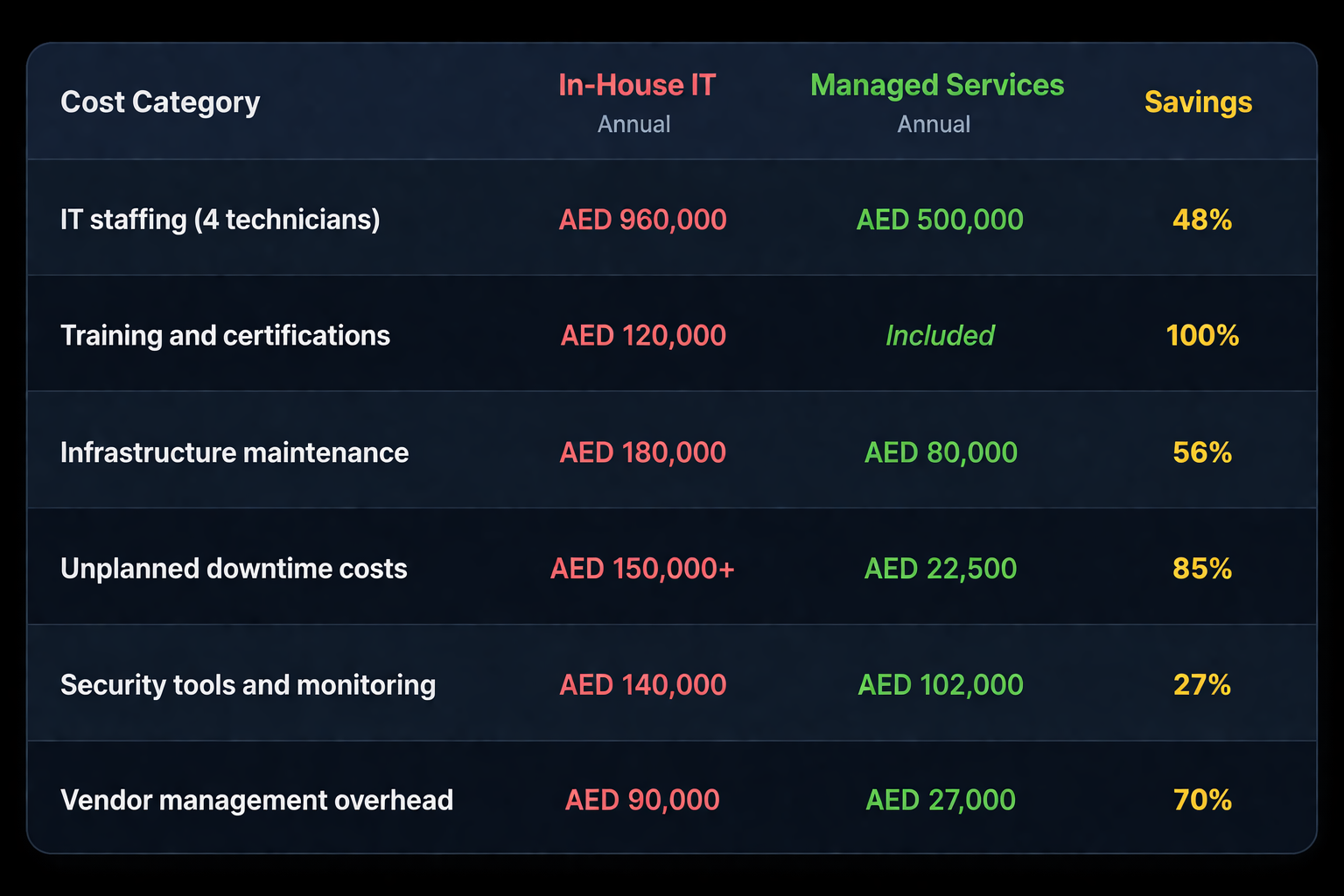
Composite estimates based on verified UAE market benchmarks for a 100-employee organisation.
Managed services replace this fragmented cost structure with a single, predictable monthly agreement. Budgets become forecastable. Surprises become rare.
Our finding: Across 500+ projects delivered in the UAE, mid-size businesses transitioning to managed IT services typically reduce total IT spend by 30 to 40 per cent in the first 12 months. The largest savings come from eliminating recruitment cycles, reducing downtime, and consolidating vendor management. Organisations working alongside a technology partner to understand the hidden costs of in-house IT tend to uncover savings their internal teams hadn’t quantified.
How Do Managed IT Services Drive Cost Efficiency?
Managed services drive cost efficiency through five distinct mechanisms, each targeting a specific area where in-house IT spending leaks.
Understanding each mechanism helps organisations identify exactly where their own budgets are underperforming.
Predictable Monthly Budgeting
The subscription model eliminates capital expenditure surprises. Rather than budgeting for emergency repairs, unplanned hardware replacements, and ad-hoc software upgrades, organisations pay a consistent monthly fee that covers the full scope of IT operations.
A single unexpected server failure can cost more than several months of managed services fees. Moving to predictable pricing transforms IT from a financial uncertainty into a controlled operating expense.
Reduced Downtime and Productivity Loss
Downtime carries a price most organisations underestimate. Global research covering over 1,000 enterprises found that 91 per cent of mid-size and large organisations estimate a single hour of downtime costs over AED 1.1 million (~$300,000).
Forty-one per cent of enterprises report hourly costs between AED 3.67 million and AED 18.4 million (~$1 million to $5 million). For a company with 200 employees, even a few hours of unplanned downtime per quarter can exceed the annual cost of a managed services agreement.
That figure excludes reputational impact, regulatory consequences, or lost client confidence. The shift from reactive repair to predictive maintenance is where the largest reductions in downtime are realised.
Proactive monitoring through a managed provider identifies issues before they escalate. Dashboards, alerting thresholds, and automated remediation scripts catch failures that an in-house team wouldn’t notice until users complained.
Access to Enterprise-Grade Expertise
Hiring separate specialists for networking, security, cloud infrastructure, and helpdesk support is financially impractical for most mid-size UAE organisations. A single certified network engineer in Dubai commands over AED 250,000 annually. A cloud architect typically earns more than AED 350,000.
Managed services provide access to a full team of certified professionals under a single agreement. In the UAE, where demand for qualified IT talent consistently outpaces supply, this model delivers capability without requiring a 12-month recruitment cycle.
Why recruit for 12 months when you can partner for results in 12 days?
Consolidated Vendor Management
Organisations operating in hybrid environments often maintain relationships with 15 or more vendors. Cisco for networking, Microsoft for productivity, Dell for hardware, Fortinet for security, AWS or Azure for cloud, and so on.
Each relationship requires contract negotiation, support coordination, and invoice reconciliation. Administrative overhead adds up quickly, especially when incidents require coordinated response across multiple vendors.
Consolidating these relationships under a single managed provider simplifies operations and reduces administrative overhead. The provider negotiates vendor pricing at scale and coordinates support on behalf of the client, delivering a single point of accountability rather than a dozen.
Scalable Infrastructure Without Capital Investment
Growing businesses don’t need to purchase new servers every time headcount increases. Managed services offer a usage-based model that scales up during busy periods and contracts during periods of low demand.
No capital outlay. No stranded assets.
Organisations that partner with cloud optimisation specialists can continuously right-size their infrastructure, paying only for what they use.
How Do MSPs Lower Your Cybersecurity Costs?
Managed security services lower costs primarily by preventing breaches, automating compliance, and providing continuous monitoring at a fraction of the cost of an in-house build.
The financial stakes are substantial. The average cost of a data breach in the Middle East reached SAR 27 million (~$7.29 million) in 2025, down 18 per cent year on year but still the second-highest globally.
Lost business remained the largest cost category, averaging SAR 11.63 million per incident. A single breach can erase a full year of IT budget savings and damage client relationships that took years to build.
The regional cybersecurity market reflects this pressure. The UAE cybersecurity market is expected to reach AED 3.34 billion (~$0.91 billion) in 2026 and grow to AED 5.55 billion (~$1.51 billion) by 2031 at a 10.66 per cent compound annual rate.
Managed cybersecurity providers address this through continuous Security Operations Centre monitoring, automated threat detection, and compliance management aligned with ISO 27001, NESA standards, and the UAE Data Protection Law. Building equivalent capabilities internally requires dedicated staff, specialised tools, and ongoing training. That investment easily exceeds AED 500,000 annually for a mid-size firm.
The savings come from five distinct categories:
- Breach prevention: early detection and containment dramatically reduce the incident cost curve
- Compliance automation: continuous audit readiness replaces expensive point-in-time certification projects
- Continuous SOC monitoring: shared security operations infrastructure delivers enterprise-grade coverage at mid-market pricing
- Faster incident response: tested playbooks and threat intelligence reduce mean time to resolution.
- Reduced insurance premiums: documented managed security controls frequently qualify organisations for 10 to 20 per cent lower cyber insurance costs
Most cost analyses overlook the insurance angle entirely. Cyber insurance premium reductions compound over time and rarely factor into initial ROI calculations.
Can Cloud Optimisation Really Cut Infrastructure Costs?
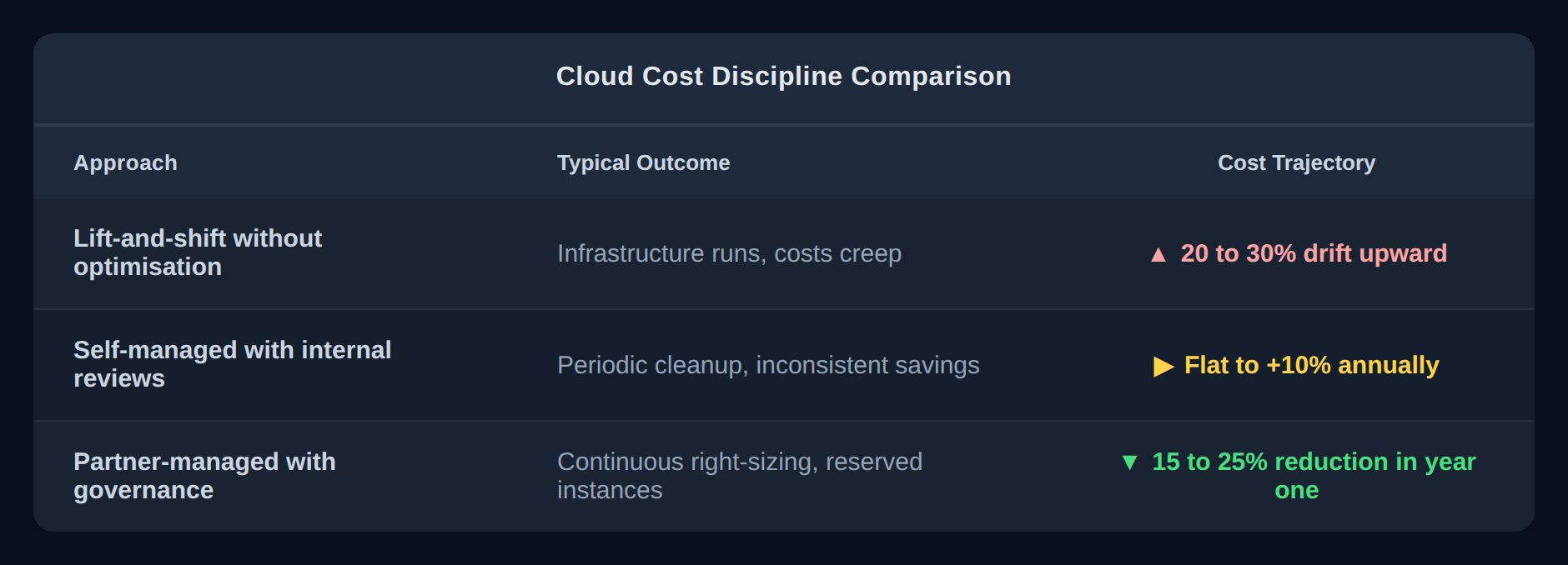
Cloud optimisation does reduce infrastructure costs, but only when actively managed. Without governance, cloud spending drifts upward as teams provision resources faster than they decommission them.
The UAE cloud environment is accelerating due to government digital transformation mandates, the expansion of local data centre infrastructure by major hyperscalers, and the growing needs of FinTech and e-commerce platforms. This creates opportunity, but also complexity.
Hybrid cloud adoption now dominates large enterprise architecture globally. Managed services play a central role in coordinating these increasingly complex environments.
The efficiency gains come from right-sizing workloads, eliminating unused resources, implementing reserved instances, and applying cost governance frameworks. Most internal IT teams lack the bandwidth to consistently manage these.
Without active management, cloud spending typically drifts upward by 20 to 30 per cent beyond initial projections within the first two years. Forgotten development environments, over-provisioned databases, and unmonitored data egress fees accumulate quietly.
MSPs bring specialised cloud optimisation expertise that helps businesses avoid the most common and costly mistake: migrating to the cloud without a cost optimisation strategy. The mistake isn’t choosing the cloud. It’s choosing the cloud without operational discipline.
What Does Managed IT ROI Look Like in Practice?
Managed IT ROI comes from three distinct components: direct cost savings, productivity gains from reduced downtime, and risk reduction from improved security posture.
A global study of 1,224 senior leaders confirms the strategic importance. 99 per cent now view managed services as strategic, with two-thirds expecting major operating and business impact within 24 months.
Here’s what the ROI looks like in a representative UAE engagement, structured around the pattern observed across our portfolio.
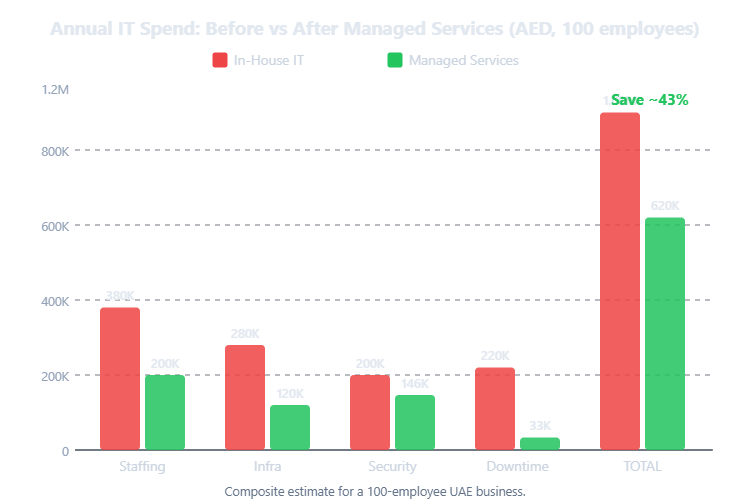
Challenge: A mid-size UAE business with 100 employees was running an in-house IT operation staffed by 4 to 5 professionals, along with infrastructure, software licences, and vendor contracts. Total annual IT spend ranged between AED 800,000 and AED 1,200,000. Budget unpredictability, recurring downtime, and cybersecurity gaps were creating operational strain and executive frustration.
Solution: The organisation transitioned to a managed services model that consolidated monitoring, maintenance, security, and vendor management under a single monthly agreement. The migration followed a phased approach, starting with infrastructure monitoring and helpdesk before expanding to full security and cloud management.
Result: Total IT costs dropped to AED 500,000 to 750,000 annually, a net saving of AED 300,000 to 450,000 per year. Unplanned downtime decreased by over 80 per cent. The organisation gained access to certified specialists across networking, cloud, and security without recruiting a single new hire.
Risk reduction is often the most valuable ROI component, though it’s the hardest to quantify until an incident occurs. A mid-size organisation that avoids a single serious breach preserves more value than a full year of staffing savings.

Ready to Cut Your IT Costs Without Cutting Capability?
Request a complimentary IT cost assessment tailored to your Emirates operation, team size, and infrastructure requirements.

Frequently Asked Questions
How much can UAE businesses save with managed IT services?
Mid-size UAE businesses typically save AED 300,000 to 450,000 annually by transitioning from in-house IT to a managed services model. Actual savings depend on company size, infrastructure complexity, and current spending levels.
Larger enterprises often see higher absolute reductions, particularly when vendor consolidation is factored in. Savings in the first 12 months are usually concentrated in eliminating recruitment cycles, reducing downtime, and consolidating vendor contracts.
Are managed IT services suitable for small businesses in Dubai?
Yes. Small businesses frequently benefit the most from this model because they cannot justify full-time specialist hires across networking, security, cloud, and helpdesk.
Managed services eliminate the need to hire full-time IT staff at an annual cost of AED 240,000 or more per technician. Managed IT services for startups and enterprises provide continuous monitoring, cybersecurity, and helpdesk support at a fraction of the cost of in-house solutions, giving smaller organisations access to enterprise-grade capabilities.
What is the difference between managed IT services and IT AMC?
IT annual maintenance contracts in Dubai cover reactive maintenance for existing hardware and software. Managed IT services go considerably further, including proactive monitoring, strategic IT planning, cybersecurity, cloud management, and ongoing optimisation.
AMC addresses problems after they occur. Managed services focus on preventing those problems in the first place. The pricing reflects this difference, and so does the value.
How do managed IT services handle cybersecurity?
Managed service providers operate continuous Security Operations Centres that monitor networks for threats around the clock. Coverage spans threat detection, incident response, compliance management, and security audits.
For UAE organisations subject to NESA standards and the UAE Data Protection Law, this level of coverage is difficult and expensive to build internally. Internal build costs for equivalent capability typically exceed AED 500,000 annually for a mid-size firm.
How quickly can a business transition to managed IT services?
Most transitions take 2 to 6 weeks, depending on the complexity of the infrastructure and the scope of services being onboarded. A phased approach works best: begin with monitoring and helpdesk, then expand to full infrastructure management over 30 to 60 days.
The first month is primarily about establishing performance baselines. Measurable efficiency gains typically appear by month three.
Conclusion
What does the data say about managed IT cost savings? Managed IT services replace fragmented spending on downtime, turnover, and vendor management with a single predictable monthly fee. For mid-size UAE businesses, this translates into annual savings of AED 300,000 to 450,000.
How much impact does proactive monitoring have on downtime? A single hour of downtime costs over AED 1.1 million for 91 per cent of mid-size and large enterprises, according to independent global research. Preventing even two hours of downtime per year can exceed the cost of a managed services contract.
What are the cybersecurity cost benefits of managed security? The average Middle East breach now costs SAR 27 million, with lost business accounting for SAR 11.63 million of that figure. Managed security services reduce this exposure through continuous monitoring, automated compliance, and documented controls that often qualify organisations for lower cyber insurance premiums.
Does cloud optimisation deliver meaningful savings? Cloud costs typically drift 20 to 30 per cent above initial projections without active governance. Structured optimisation through a managed partner reverses this trend and delivers ongoing right-sizing savings.
How are organisations viewing managed services in 2026? 99 per cent of senior leaders now view managed services as strategic rather than tactical, according to global research of 1,224 respondents. Two-thirds expect major operating impact within 24 months.
For UAE businesses navigating digital transformation, rising cyber threats, and a competitive talent market, the cost efficiency argument for managed services has never been stronger.
Ready to see what these numbers look like for your organisation? Connect with a regional expert for a complimentary IT cost assessment tailored to your infrastructure, team, and growth plans.