
Your finance team cannot access the ERP system. The ticketing platform is down. You call your IT contact and learn he is on another job until tomorrow afternoon. Operations are stalled, the CFO wants answers, and your compliance officer is asking who logged the incident.
That is the break-fix model in practice. It works until something important fails at the wrong time, and when it does, the cost extends far beyond the technician’s invoice.
For GCC organisations facing rising regulatory pressure, larger breach exposure, and faster digital transformation, the model is increasingly hard to defend. The regional shift away from reactive IT is accelerating. The Middle East managed services market reached $25.7 billion in 2025 and is growing at 13.66% per year. MENA IT spending will hit $169 billion in 2026, an 8.9% increase from 2025.
Key Takeaways
- Managed IT delivers predictable monthly costs, while break-fix bills accumulate without warning.
- The average cost of a Middle East data breach was SAR 27 million in 2025, the second-highest globally.
- NCA, NESA, and PDPL compliance require continuous monitoring that break-fix cannot provide.
- Managed IT guarantees response times through SLAs, with response times of 15 minutes to 1 hour for critical incidents.
- Co-managed IT is the strongest fit for mid-size GCC organisations with existing internal teams.
- Break-fix remains viable only for micro-businesses in low-risk, non-regulated sectors.
What Is Break-Fix IT Support?
Break-fix IT is a purely reactive support model with no ongoing monitoring, service-level agreements, or preventive maintenance. Something breaks, you call someone to fix it, and you pay only for the work performed.
The arrangement is pay-as-you-go, with no monthly fee and no contract obligation between calls. Hourly rates from independent IT contractors in the GCC typically range from $150 to $300, with no cap on total cost per incident.
There is no team watching your systems between calls: no patch management, no proactive security, and no audit trail of what was done.
When Break-Fix Still Makes Sense
Break-fix is not gone from the GCC. It still works for a narrow audience:
- Micro-businesses with fewer than 5 employees and non-critical IT systems
- Low-risk settings where a day of outages will not disrupt core operations
- One-off projects, such as a server migration or office setup, where ongoing support is not required
The concern is straightforward. One ransomware event or major server failure can erase years of apparent savings overnight, particularly in a region where extortion and ransomware now drive over half of all cyberattacks globally.
What Are Managed IT Services?
Managed IT services provide proactive, ongoing technology support for a fixed monthly fee, typically $100 to $250 per user. That covers around-the-clock monitoring, cybersecurity, patching, help desk support, backup, disaster recovery, and strategic IT planning.
Unlike break-fix, managed IT is a partnership. You work with a dedicated team or virtual CIO who understands your setup, plans upgrades, and addresses problems before they cause outages.
For GCC organisations navigating NCA, NESA, or PDPL requirements, that ongoing relationship is often what makes compliance possible.
What a Typical MSP Includes
- Continuous network monitoring with automated alerting
- Endpoint detection and response (EDR)
- Automated patching and software updates
- Help desk with SLA-backed response times
- Backup and disaster recovery testing
- Strategic planning, budgeting, and vendor management
- Compliance documentation aligned with regional frameworks
How Do Costs Compare: Break-Fix vs Managed IT?
Managed IT delivers more predictable costs and stronger protection against high-impact incidents. The cost case is built on what each model includes, what it excludes, and the average cost of a GCC breach when prevention fails.
The average data breach in the Middle East costs SAR 27 million, roughly $7.29 million in 2025, the second-highest globally, behind only the United States. That single number reframes the entire cost conversation. Preventing one major incident over a multi-year period can offset years of managed IT investment.
Break-fix bills accumulate without warning. Emergency call-outs, parts replacement, and unplanned recovery work all sit outside the budgeting cycle. Proactive IT bundles those categories into a single monthly number.
We see this pattern across GCC organisations. A 40-person Riyadh-based firm running break-fix typically spends $8,000 to $12,000 per year on emergency calls alone. After switching to a managed IT partner, unplanned IT costs drop substantially within the first six months. The savings often fund a security stack upgrade aligned with NCA requirements.
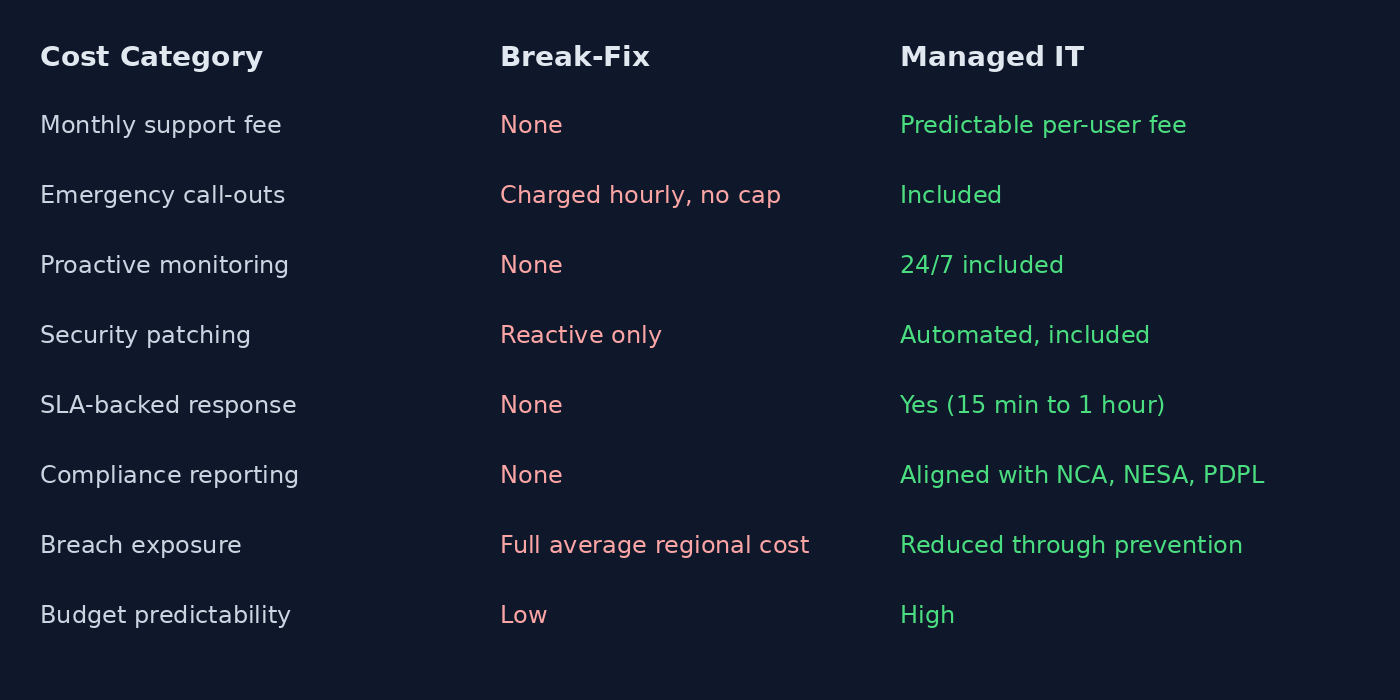
Our finding: Cost predictability is the under-appreciated advantage of managed IT in the GCC. Breach exposure, audit-driven remediation work, and downtime losses are all volatile expenses for break-fix users. Managed IT shifts those line items from “unknown emergency” to “fixed monthly cost,” which matters more for procurement and budgeting than raw cost comparisons suggest.
Which Model Provides Better Cybersecurity Protection?
Managed IT wins on security. The gap is significant in the GCC, where the regional threat environment is more intense than the global average.
The Middle East faced roughly 3,000 tracked cyberattacks in 2024, with DDoS attacks accounting for 73% of all incidents. The average breach in the region costs SAR 27 million, the second highest globally. Break-fix offers zero proactive defence: no monitoring, no patching, no threat detection, no employee training.
With an MSP partner, you get a layered security stack. That means endpoint detection, firewall management, automated patching, and security awareness training. Prevention is significantly more cost-effective than recovery, particularly for organisations subject to NCA, NESA, or PDPL enforcement.
The data shows where regional gaps still exist. 26% of GCC organisations rate their cyber risk as high, while 27% allocate only 0% to 25% of their cybersecurity budget to threat detection and incident response. That disconnect between perceived risk and actual investment is the precise gap managed IT closes.
The Long-Tail Cost Most Guides Ignore
Here is something most break-fix vs. managed IT comparisons miss. 51% of data breach costs are incurred more than 1 year after the event. In the GCC, that long tail is compounded by regulatory follow-up that can extend the financial impact for years.
NCA audit follow-up. When a Saudi organisation experiences a breach, the National Cybersecurity Authority can mandate ongoing reviews and remediation work for 12 to 24 months. That includes documentation, control implementation, and verification cycles that consume internal resources and external advisory fees long after the technical incident is resolved.
PDPL enforcement timelines. Saudi Arabia’s PDPL requires breach notification within 72 hours. Missing that window triggers escalating penalties and forces a defensive posture that drains legal and compliance budgets for months afterward.
Regional reputational tail. GCC B2B markets are tight. News travels through chambers of commerce, family business networks, and government procurement channels faster than it does through the press. A breach that becomes public can affect contract renewals, partner relationships, and government tender eligibility for two to three years.
Contract termination clauses. Government contracts in the UAE and KSA increasingly include cybersecurity compliance requirements as conditions of award. A breach that exposes non-compliance can trigger immediate termination, with cascading revenue impact across the affected business unit.
Break-fix support cannot detect a breach in progress, let alone manage the regulatory and commercial fallout that follows. Managed IT providers run constant monitoring that catches intrusions early, often before data leaves the network, and produce the audit trail that regulators and partners require afterward.
How Do Response Times and Downtime Compare?
Managed IT providers guarantee response times through SLAs. Break-fix offers no such guarantee, and the gap is the single most measurable operational difference between the two models.
Downtime costs for mid-size firms can exceed $300,000 per hour, for GCC organisations with teams distributed across Riyadh, Dubai, Doha, and beyond, a single outage can sideline workers in multiple locations at once.
The SLA gap is straightforward.
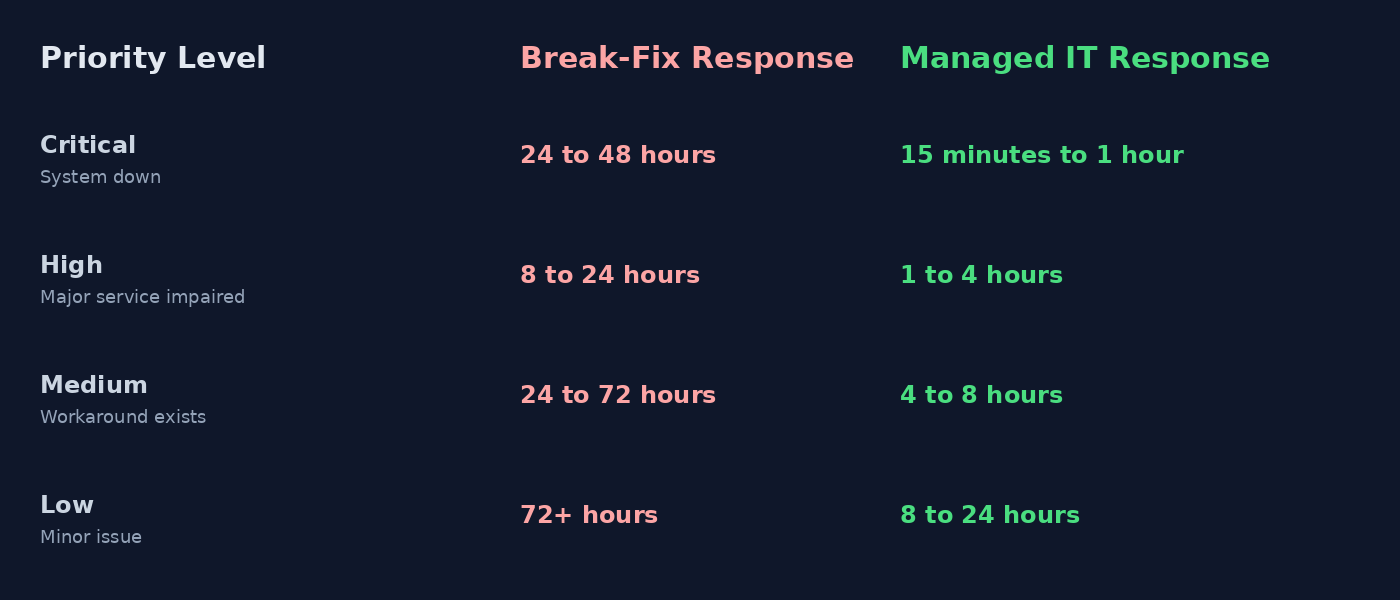
Under managed IT, proactive oversight catches most issues before they cause outages. Under break-fix, every incident is a manual trigger that waits in line behind whatever else the technician is handling.
How long can your organisation afford to wait?
What About GCC Compliance and Regulatory Requirements?
Compliance is the most overlooked factor in the break-fix vs. managed IT decision for GCC organisations. NCA, NESA, PDPL, DIFC, and PCI DSS all require continuous monitoring, access controls, and audit trails that reactive support cannot provide.
NCA Essential Cybersecurity Controls (ECC) mandate 114 controls across 5 domains for all Saudi government entities and critical infrastructure operators. Non-compliance carries regulatory sanctions, restrictions on government contract participation, and legal exposure. In the UAE, NESA requires 188 security controls for government and critical-sector organisations.
Compliance is not optional in the GCC. It is a condition of doing business.
Regulators in both KSA and UAE have increased enforcement significantly since 2024. For organisations in healthcare, finance, government, and critical infrastructure, the question is not whether managed IT is worth the cost. It is whether the organisation can operate legally without it.
Saudi Arabia’s PDPL, fully enforceable since September 2024, requires 72-hour breach notification, data protection impact assessments, and strict controls on cross-border transfers. The DIFC Data Protection Law in Dubai imposes fines of up to $100,000, with scope for higher penalties in serious cases.
Managed IT providers offer compliance-as-a-service that covers automated patch management, access logging, continuous monitoring, regular security scans, and documented incident response plans aligned with the NCA ECC and NESA frameworks.
Break-fix leaves you with gaps. No audit trail. No compliance reporting. No proof of preventive controls. When a regulator requests documentation, the organisation has limited recourse.
Our finding: Compliance is what forces the switch for most GCC organisations. Many run break-fix without realising they fall short of regulatory standards until an audit or breach makes the gap visible. By then, the cost of remediation often exceeds what years of managed IT would have cost.
What Is Co-Managed IT and Who Should Consider It?
Co-managed IT pairs your internal IT team with an MSP partner, combining in-house knowledge with 24/7 specialised coverage. Most providers now offer both break-fix and managed service models, and the hybrid option has become increasingly practical for GCC mid-market organisations.
The model is often the smartest choice for organisations that want to retain in-house expertise while adding compliance support and after-hours coverage they cannot afford to maintain in-house.
How Co-Managed IT Works in Practice
- Your internal IT team handles desktop support, user onboarding, and vendor management.
- The MSP handles continuous monitoring, cybersecurity, escalation support, and overflow capacity.
- Compliance documentation is shared, with the MSP producing audit-ready reports for NCA or NESA.
- The MSP provides specialised expertise (cloud, security, regional frameworks) that the internal team cannot economically maintain in-house.
Best-Fit Profiles for Co-Managed IT
- Organisations with 50 to 500 employees that already have 1 to 3 internal IT staff
- Companies outgrowing break-fix but not ready to fully outsource
- Groups with NCA or NESA compliance needs that exceed internal team capacity
- Multi-country GCC operations that need consistent support coverage across emirates and borders
Most break-fix vs. managed IT articles present a false binary. The reality in the GCC is more nuanced. Co-managed IT fills the gap that neither the pure model covers and allows organisations to combine local knowledge with global best practices.
Which Model Is Right for Your Organisation?
The right choice depends on two factors: organisation size and industry sector. The decision matrix below maps the standard recommendations across both axes for GCC organisations.
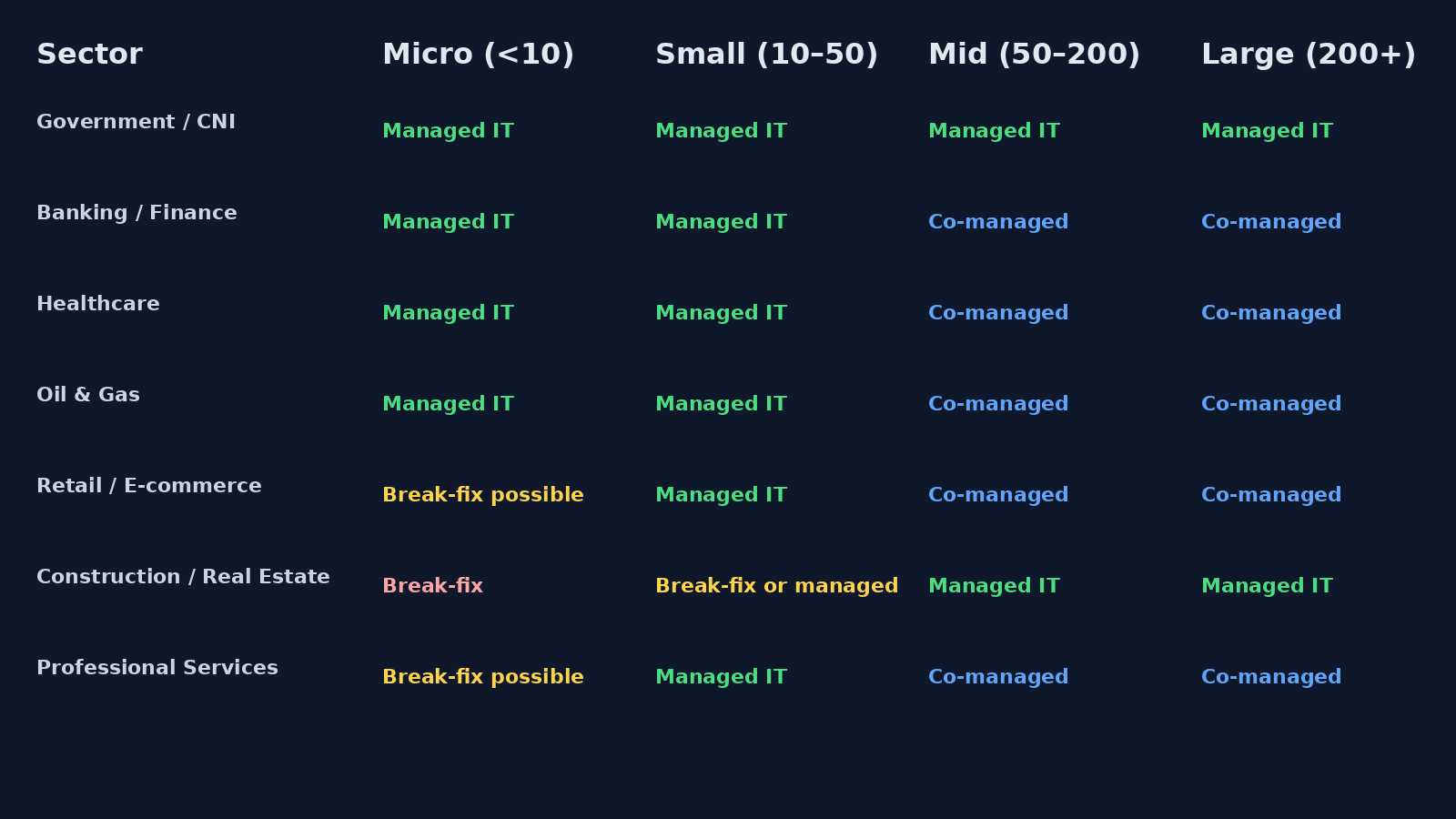
The pattern is clear. Regulated sectors require managed IT regardless of size. Mid-size organisations across most sectors benefit most from co-managed IT. Break-fix remains viable only for micro-businesses in low-risk industries.
The Middle East managed services market reached $25.7 billion in 2025. The trend is unmistakable: GCC organisations are moving toward proactive IT support faster than the global average, driven by regulatory pressure and the rising cost of incidents.
How many employees depend on your systems to do their work? What happens to revenue if your infrastructure goes down for a full day? Those two questions answer most of the choices for most organisations.

See where your IT model stands today.
Get a free GCC IT maturity assessment to understand where your current support model falls on the break-fix-to-managed IT spectrum. The report includes a gap analysis against NCA, NESA, and PDPL requirements, along with actionable recommendations tailored to your team's size and sector.

Frequently Asked Questions
What does NCA compliance actually require an MSP to provide?
NCA Essential Cybersecurity Controls require MSPs serving Saudi clients to deliver documented evidence across all 114 controls in scope for the client. That includes continuous monitoring with logged events, automated patch management with remediation timelines, identity and access management with segregation of duties, incident response plans with tested recovery procedures, and quarterly review reports.
The MSP must also support the client through NCA audits, providing technical evidence and remediation work as findings emerge. An MSP without explicit NCA ECC capabilities cannot legitimately serve regulated Saudi organisations.
Can a Riyadh-based business work with a Dubai-based MSP?
Yes, with conditions. Cross-border MSP relationships are common in the GCC, particularly for specialised services like cloud architecture, advanced security operations, and compliance consulting.
The conditions to verify are data residency (where your data physically resides), cross-border transfer compliance under KSA PDPL and UAE data protection law, response time guarantees (SLAs must account for regional support presence), and on-site availability when physical work is required. Many leading MSPs operate through hubs in both Riyadh and Dubai for exactly this reason.
How does co-managed IT work with NCA’s Saudi cybersecurity workforce requirements?
NCA workforce expectations call for critical roles to be filled by Saudi nationals, particularly within the cybersecurity function of regulated organisations. Co-managed IT supports this directly.
The internal team retains its Saudi-staffed cybersecurity function while the MSP provides specialised expertise, after-hours coverage, and surge capacity that would be uneconomic to maintain in-house. The MSP operates as an extension of the internal team, with clear role boundaries documented in the service agreement and shared with NCA auditors when requested.
What should a GCC organisation look for when evaluating MSP SLAs?
Look beyond response time commitments. The strongest MSP SLAs in the GCC include the following:
- Response time tiers for critical, high, medium, and low priority incidents
- Resolution time targets, in addition to response times
- Compliance documentation guarantees alignment with NCA ECC, NESA, and PDPL requirements
- Regional support presence with named technical contacts in your emirate or city
- Penalty clauses for missed SLAs, typically as service credits
- Quarterly performance reviews with documented metrics
How do I transition from break-fix to managed IT?
Start with an IT assessment. Inventory your current systems, identify compliance gaps against the NCA ECC or NESA frameworks, and compare 3 to 5 MSPs based on their SLAs, security stack, regional presence, and industry experience.
Most transitions take 30 to 90 days. A good MSP provides a clear transition plan and runs side-by-side support during the changeover.
What Should GCC Organisations Do Next?
The case for managed IT will get stronger every month through 2026, not weaker. Three forces are converging, making this analysis more urgent than it was even one year ago.
NCA enforcement is accelerating. Audits that were rare in 2023 are now routine in 2025, particularly for government contractors and critical infrastructure operators. Organisations running break-fix are increasingly exposed during compliance reviews.
PDPL fines are being applied. The Saudi Personal Data Protection Law has been enforceable since September 2024, and the first wave of meaningful penalties is being issued through 2025 and into 2026. The cost of non-compliance is moving from theoretical to actual.
The threat environment is intensifying. Extortion and ransomware now drive over half of all cyberattacks globally, and the Middle East remains a high-cost target with breaches averaging SAR 27 million. Break-fix support cannot meet that threat.
For mid-size GCC organisations caught between in-house and fully outsourced models, co-managed IT bridges the gap. For everyone else, the question is no longer whether to make the switch. It is when, and with which partner.