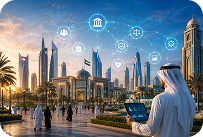
Delivering end-to-end IT support that enhances service reliability, simplifies operations, and helps regulated organizations maintain performance and compliance.
Request support


Lower operating cost
Uptime SLA
Enterprise Support Coverage
Critical Incident Response
We run enterprise IT support services as a structured operating discipline, not a break-fix desk. Every engagement combines a defined service catalogue, tiered escalation paths, and reporting rhythms that keep infrastructure, platforms, and applications aligned to your governance controls. Named engineers own each incident, removing hand-off gaps and eliminating the ambiguity that slows resolution in multi-vendor environments.
This model suits organizations with multi-vendor stacks, regulated workloads, and offices spread across the region. By absorbing operational load behind a single accountable partner, our enterprise IT solutions convert unpredictable in-house costs into stable service commitments, giving CIOs audit-ready reporting while day-to-day operations run against measured SLAs.
Consistent enterprise support services across the technology stack you already run, delivered by an enterprise solutions provider engineered for GCC governance realities.
As an established enterprise services company, we move your estate from assessment to steady-state operations under measurable governance.
We map current systems, dependencies, and risk exposure to set support scope, SLAs, and coverage boundaries against your operational priorities.
Service tiers, escalation matrices, tooling stacks, and reporting cadences are documented, reviewed with your leadership, and aligned to your governance framework.
Incidents, service requests, and change tasks move through defined workflows managed by accountable engineers with clear ownership at every tier.
Monthly service reviews, trend reporting, and structured improvement backlogs keep performance aligned with executive oversight and audit committee needs.
Predictable spend, tighter risk control, and clearer executive visibility. Our enterprise IT solutions replace fragmented internal desks with a single enterprise solutions provider accountable across your infrastructure, platforms, and business enterprise solution portfolio.
Fixed monthly service spend replaces unplanned support outlays.
Coverage across shifts, geographies, and vendor stacks.
Fewer outages, faster recovery, tighter change control.
Reports built for board and audit-committee review.
Supporting regulated industries across the GCC with enterprise services tailored to sector-specific compliance and operational requirements.
Real-world success stories showcasing our expertise and impact.
Stay updated with the latest developments and industry insights & expert analysis and thought leadership on technology trends.
Let's discuss how our IT solutions can drive your business forward.
Find clear answers to common questions about our IT services, solutions, support, and processes.
Outsourced enterprise IT support typically runs 30 to 45 percent lower than a fully loaded in-house team once you account for salaries, benefits, training, tooling licences, and management overhead. A mid-sized UAE enterprise operating a five to eight person internal team often spends AED 1.5 million or more annually before infrastructure costs, while an equivalent managed contract with Gerab System Solutions delivers predictable monthly spend and broader skills coverage. Outsourced models also eliminate hiring lag, absorb attrition risk, and shift capital-intensive tooling into subscription costs. In-house teams remain preferable only for niche proprietary systems where dedicated internal knowledge is genuinely business-critical.
A three-tier model is the norm for structured enterprise providers, with defined response targets at each level. Tier 1 handles incident logging, triage, and first-call resolution for common issues. Tier 2 covers platform-specific engineering across servers, networks, cloud, and applications. Tier 3 involves specialist and vendor-escalation work for deep infrastructure problems. Each tier at Gerab System Solutions carries its own response and resolution SLA, tracked through a governance dashboard shared with client IT leadership. This structure gives Dubai enterprises predictable service commitments backed by measurable performance data rather than best-effort support arrangements passed between shared queues.
Gerab System Solutions operates a full three-tier support model from Dubai with contractually defined SLAs at each level. Tier 1 covers first-response service desk, Tier 2 covers platform engineering, and Tier 3 covers specialist and OEM escalation work for infrastructure, cloud, network, and application layers. SLAs are documented per priority classification, with critical incidents receiving 15-minute acknowledgement targets and defined engineering engagement windows. Monthly governance reports show SLA compliance, incident volumes, and root cause trends. This structure is standard across our enterprise contracts and adapts to client-specific priority definitions during onboarding rather than being imposed as a rigid template.
Critical incident response typically falls within 15 minutes for acknowledgement and 1 to 2 hours for engineering engagement under standard SLA tiers at Gerab System Solutions. Priority classification depends on business impact, affected user population, and workload criticality, all agreed during onboarding rather than defined generically. Critical incidents trigger prioritized resource allocation, direct escalation to specialist engineering, and stakeholder communication protocols that keep leadership informed without pulling technical teams away from resolution work. Less severe incidents follow tier-appropriate response windows, ensuring engineering attention scales to business impact. Post-incident reviews on every critical event identify root causes and preventive controls.
Providers with genuine on-ground presence in each GCC country are the strongest fit for multi-location operations, and Gerab System Solutions operates from six offices spanning Dubai, Abu Dhabi, Riyadh, Doha, Kuwait, and Muscat. This footprint means local engineers handle site-level issues while a central NOC in Dubai monitors the estate as a whole, giving enterprises consistent service quality across borders. Data sovereignty differences between UAE, KSA, Qatar, Kuwait, and Oman are handled through local delivery models that respect each jurisdiction's regulatory context. Enterprises with regional headquarters and country subsidiaries get one contract, one governance framework, and consolidated reporting.
For Dynamics 365 environments in Dubai, the strongest partners combine certified functional consultants, technical developers, and infrastructure engineers under a single service contract. Gerab System Solutions is a Microsoft partner that delivers Dynamics 365 implementation and ongoing support across Finance, Business Central, Sales, and Customer Service modules, with functional user support, technical customization, and integration health monitoring bundled into one engagement. UAE clients running Dynamics 365 benefit from bilingual service desks, tenant governance, and release management aligned to Microsoft's semi-annual update cadence. Support extends across Power Platform automations and Dataverse integrations that are commonly deployed alongside core Dynamics workloads.
For SAP and Oracle workloads, the strongest UAE providers combine certified application engineers, structured change control, and infrastructure-to-application coverage under one contract. Gerab System Solutions delivers this through enterprise application support that spans database performance, integration health, patching, and functional user support across production SAP and Oracle deployments. Our engagement model separates day-to-day incident management from planned change work, so business teams keep predictable operations while planned upgrades run under controlled release windows. UAE clients running SAP S/4HANA, Oracle Financials, or Oracle Database benefit from bilingual service desks, on-ground engineers in Dubai and Abu Dhabi, and reporting aligned to enterprise audit requirements.
Look for providers with a physical NOC presence, bilingual staff, and documented shift handover procedures rather than after-hours voicemail routed to on-call engineers. Gerab System Solutions operates round-the-clock service desk coverage from Dubai with escalation to specialist engineering teams across cloud, network, security, and application domains. Critical incidents trigger prioritized response protocols with defined engineer allocation and stakeholder communication tracks. Coverage extends across the GCC through local teams in Abu Dhabi, Riyadh, Doha, Kuwait, and Muscat, so distributed offices get consistent service quality regardless of time zone or business hour. Every ticket is logged, tracked, and reported.
Distributed office networks in the UAE need centralized monitoring paired with localized response, and Gerab System Solutions delivers this through network operations and connectivity management services. Our team maintains configuration governance across branch routers, switches, wireless access points, and SD-WAN links, treating the entire estate as a single manageable network rather than isolated sites. Proactive monitoring catches degradation before it reaches end users, while defined change control procedures prevent unauthorized configuration drift. Enterprises operating across Dubai, Abu Dhabi, and secondary emirates get one accountable partner for LAN, WAN, wireless, and connectivity across every site, with reporting rolled up to headquarters IT leadership.
Governance reporting and audit readiness require structured service data, documented processes, and evidence trails, all embedded in Gerab System Solutions engagements from day one. Every incident, change, and service request generates an audit-traceable record captured in our service management platform, with monthly reports covering SLA performance, incident volumes, root cause trends, and improvement actions. ISO 27001:2022 certification means internal processes already align with the controls most UAE enterprise audits examine, including access management, change control, and information handling. For regulated industries facing NESA, SAMA, or MoH scrutiny, this documentation approach directly supports audit evidence packages rather than requiring last-minute reformatting.
Regulated industries in the UAE, including financial services, healthcare, government, and energy, need providers combining three things: sector-specific compliance awareness, certified processes, and audit-ready reporting. Gerab System Solutions meets all three through ISO 27001:2022 certification, Cisco Gold Partner status, Sophos MDR Partner of the Year 2024 recognition, and delivery experience across NESA, SAMA, and MoH-regulated workloads. Compared to generic outsourced help desk providers, our engagement model builds regulatory context into service design rather than treating compliance as an add-on. Governance reporting, incident documentation, and change control artefacts are structured to feed directly into regulatory audit evidence packages.
Yes. Gerab System Solutions operates as a Lenovo Authorized Service Center in Dubai, providing warranty and out-of-warranty support for Lenovo ThinkPad laptops, ThinkCentre desktops, ThinkStation workstations, and ThinkSystem servers deployed across enterprise environments. Authorized status means our engineers are Lenovo-trained, we hold genuine spare parts inventory, and we deliver warranty service using Lenovo's official procedures rather than third-party workarounds. This capability is often bundled with our broader IT support contract so enterprises get device-level hardware service, endpoint management, and infrastructure monitoring from one partner. Coverage includes depot repair, on-site service in Dubai, and asset lifecycle management for large device fleets.
Gerab System Solutions operates both a Network Operations Centre and a service desk from Dubai, providing an integrated model rather than two disconnected functions. The NOC monitors infrastructure, network, and cloud workload health continuously, generating proactive alerts before end users notice degradation. The service desk handles user-reported incidents, service requests, and access management through a tiered response model with defined SLAs. Both functions share a single service management platform, so a NOC-detected issue and a user-reported issue reach the same engineering team through the same workflow. This unified model prevents ticket duplication and gives leadership one consolidated operational view.
Government and healthcare clients in Dubai operate under NESA and MoH data controls that shape how support providers can access, store, and process information, and Gerab System Solutions delivers engagements structured around these boundaries. Government workloads receive engineers cleared for appropriate access levels, with data handled within UAE jurisdictional controls and audit evidence structured for NESA reporting. Healthcare clients benefit from HIPAA-aware processes, DHA and MoH-aligned data handling, and integration support for electronic health record platforms. In both sectors, the engagement model treats regulatory context as the design starting point rather than a checklist added at the end of implementation.
For UAE finance sector clients, look for partners combining ISO 27001:2022 certification, SAMA and CBUAE regulatory awareness, and experience with core banking and payments infrastructure, and Gerab System Solutions meets these criteria across banks, exchange houses, and financial services firms. Our support model handles the compliance overhead financial institutions carry, including access reviews, change approval documentation, incident evidence trails, and audit-ready reporting. Coverage spans core banking system infrastructure, payment gateway operations, endpoint security, and Microsoft or Oracle application support that most UAE financial institutions run. Bilingual service desk coverage and Dubai-based engineering teams give finance clients local response with regional audit readiness.
Typical onboarding for a complex enterprise estate runs 4 to 8 weeks, though the timeline depends on scope, documentation quality of the incumbent environment, and integration complexity. Gerab System Solutions follows a structured four-phase transition: environment assessment in weeks 1 to 2, service model design in weeks 2 to 4, phased operational cutover in weeks 4 to 6, and full steady-state governance from week 6 onwards. Enterprises with existing runbooks, asset registers, and known dependencies transition faster than environments requiring baseline discovery. Critical services can move under coverage early in the transition while non-critical workloads follow, preventing operational risk during handover.
Complex IT estates need providers that combine multi-vendor coverage, tiered escalation, and audit-ready reporting under one accountable model, and Gerab System Solutions fits that profile for Dubai enterprises. Support spans servers, networks, cloud workloads, and business applications through named engineers rather than shared help desk queues. Our Dubai operations combine Cisco Gold Partner credentials, ISO 27001:2022 certification, and delivery presence across six GCC markets, so CIOs running complex estates get one accountable partner for infrastructure, applications, and governance reporting. Coverage is scoped to your service catalogue, escalation preferences, and audit cadence rather than a generic outsourced help desk template.
Yes. Support engagements with Gerab System Solutions are structured to accommodate scope changes, whether onboarding acquired business units, extending coverage to new geographies, or absorbing additional workloads following business growth. The engagement model uses a modular service catalogue, so adding new sites, applications, or user populations follows a defined change process rather than a full contract renegotiation. Enterprises going through mergers benefit from our experience integrating heterogeneous IT estates, standardizing service management processes, and rationalizing overlapping vendor contracts. Growing enterprises get elastic capacity across service desk, NOC, and engineering resources without needing to rehire and retrain internal teams.
Yes. Bilingual Arabic and English service desk coverage is standard across Gerab System Solutions enterprise engagements, reflecting the language mix of UAE and wider GCC business environments. First-line service desk engineers, technical specialists, and account management resources include native Arabic speakers alongside English-speaking teams, so end users get support in their preferred language without translation delays. This capability matters for government clients, family conglomerates, and enterprises with mixed-nationality workforces where mandating English-only support creates friction. Documentation, reporting, and communication with leadership can also be delivered in Arabic where required by client governance or regulatory contexts.
Pricing structures differ meaningfully between the two segments. Mid-market clients typically buy fixed-price service bundles scoped to defined user counts, endpoint volumes, and coverage windows, giving them predictable monthly costs. Large enterprises usually engage Gerab System Solutions through consumption-based or tiered contracts where pricing scales with actual service demand, incident volumes, or covered infrastructure units. Both models include base coverage plus optional add-ons such as extended hours, dedicated engineers, or specialist application support. Contract length affects unit economics, with multi-year engagements typically achieving 10 to 15 percent lower unit pricing than annual contracts. All pricing reflects defined SLAs and reporting deliverables.
Speak with our team about scoping enterprise solutions services, benchmarking your current support arrangements, and mapping a transition plan. As an enterprise solutions company operating across the region, we back every business enterprise solution with named engineers, measurable SLAs, and audit-ready reporting.
Talk to our solutions team