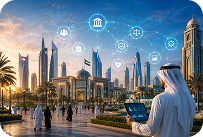
Deploy resilient IT infrastructure solutions in Abu Dhabi that meet ADHICS, NESA, and sector residency mandates while scaling for AI, analytics, and 24/7 operations.
Schedule Your Infrastructure Assessment


Years in the Region
Enterprise Deployments
Uptime SLA Commitment
Countries of Operation
Infrastructure is now the ledger every regulator, auditor, and board committee reads first. Across Abu Dhabi's regulated sectors, workloads have shifted from steady-state ERP to AI training, real-time analytics, and cross-border data flows that legacy estates were never designed to carry. When the underlying fabric fractures, the visible costs are downtime and audit findings, but the deeper cost is stalled transformation.
Our IT infrastructure solutions in Abu Dhabi are engineered for enterprises operating under ADHICS, NESA, ADGM, and sector-specific data classification rules. As one of the specialised IT infrastructure companies in Abu Dhabi covering full lifecycle delivery, we handle data centre modernisation, hybrid architecture, AIOps observability, and IT/OT convergence so that regulatory posture and workload performance move in the same direction.
Regulators tighten controls every year, workloads grow denser, and executive committees expect resilience proven with evidence. These are the five friction points we consistently uncover during scoping visits to enterprise estates in the capital.
Every gap listed above maps to a defined capability inside our cloud infrastructure services in Abu Dhabi. Here is how each one is scoped, deployed, and operated inside your environment.
Waiting for a user ticket means the outage is already commercial. Our AIOps layer ingests telemetry across compute, storage, network, and application tiers, then correlates anomaly signatures so degradation is caught before service impact. Mean time to recovery falls by roughly 75 percent in mature deployments.
Fixed-function hardware caps whatever the business wants to build next. We replace aging racks with software-defined compute, flash-native storage, and orchestration frameworks that carry AI workloads, elastic scaling, and workload mobility without forcing application rewrites or refactoring cycles.
Ungoverned hybrid estates create audit gaps and duplicated licensing spend. A single control plane governs on-premises, private, and public cloud workloads under shared identity, security, and cost policy, keeping regulated data inside approved jurisdictions while elastic workloads use hyperscaler capacity.
Plants, substations, and field devices cannot remain invisible to the enterprise. Convergence brings ICS and SCADA estates into segmented, monitored zones, giving operations, security, and finance leaders one operational picture spanning every connected asset across corporate and industrial networks.
We partner with global infrastructure OEMs including Cisco, Microsoft, HPE, IBM, Oracle, Sophos, and VMware to deliver compute, network, storage, virtualisation, and observability stacks matched to your workload profile, compliance perimeter, and long-term architecture roadmap.
As a trusted IT infrastructure services provider in Abu Dhabi, we deliver measurable outcomes across regulated deployments spanning finance, energy, healthcare, and public sector environments in the capital.
MTTR reduced by up to 75 percent through AIOps observability.
Total cost of ownership reduced 45 to 65 percent post-modernisation.
80 percent drop in unplanned critical infrastructure outages.
New enterprise services go live 50 percent faster.
Our enterprise infrastructure solutions in Abu Dhabi are engineered for sectors where uptime, data residency, and audit readiness carry direct regulatory and financial weight across the emirate.
Practical guidance from our engineering and advisory teams on AIOps, hybrid design, data center modernization, and infrastructure economics for regional enterprise leaders.
Discover how enterprises across the region have transformed their operations, strengthened compliance, and achieved measurable results with Gerab's solutions.
Let's discuss how our IT solutions can drive your business forward.
Answers to the questions enterprise buyers ask most often when scoping a cloud infrastructure engagement, from cost models to compliance to post-deployment support.
Gerab System Solutions ranks among the leading IT infrastructure providers in the capital for regulated enterprise workloads. We combine ISO 27001:2022 certification, Cisco Gold Partner status, and Sophos MDR Partner of the Year 2024 recognition with a regional delivery footprint across Abu Dhabi, Dubai, Riyadh, Doha, Kuwait, and Muscat. Our scope covers data centre modernisation, hybrid cloud, AIOps observability, and IT/OT convergence, each mapped to your workload economics, ADHICS or NESA obligations, and business SLAs. With 500 plus enterprise deployments and a 95 percent customer retention rate, our engagements start with a scoped infrastructure assessment rather than a templated reference design.

Regulated buyers should filter for providers that combine ISO 27001:2022 certification, live SOC delivery capability, and documented sector experience across finance, energy, healthcare, and public sector. Gerab System Solutions meets that bar with a 100 percent successful implementation record and vendor-certified engineers across Cisco, Microsoft, HPE, Sophos, IBM, and Oracle. We design cloud architectures around ADHICS for healthcare, NESA and SIA guidance for federal entities, and ADGM or SAMA rules for financial services, keeping regulated data inside approved jurisdictions while non-sensitive workloads use hyperscaler capacity. The outcome is a verifiable compliance posture without sacrificing elasticity or modernisation pace.
Both capabilities need to sit inside a single delivery scope, or the handoff between teams creates rework and cost overruns. GSS delivers both under one architecture, one delivery pod, and one governance model. Data centre modernisation replaces rigid compute and storage with software-defined estates ready for AI and analytics workloads, while hybrid cloud architecture governs workloads across on-premises, private, and public cloud through unified identity, security, and cost policy. We sequence the two so modernisation creates the platform, hybrid design places the workloads, and AIOps observability keeps the estate visible from data centre through cloud to the edge.
TCO for enterprise modernisation typically drops 45 to 65 percent versus the legacy baseline once workloads are re-platformed and hybrid placement is optimised. Absolute project cost depends on estate size, licensing model, migration complexity, and whether AIOps observability and IT/OT integration are inside scope. Gerab System Solutions structures pricing across capital, subscription, and managed operations lines so finance leaders see the tradeoffs clearly before commit. Every proposal begins with a scoped infrastructure assessment covering current inventory, workload profiles, compliance obligations, and target state, so numbers reflect your environment rather than a generic regional average.

Yes. AI workloads need GPU-ready compute, high-throughput storage, low-latency fabric, and observability that surfaces pipeline drift early. Gerab System Solutions designs cloud architectures for AI training, fine-tuning, and inference workloads across hybrid and public cloud footprints. Our reference architectures cover accelerated compute, distributed storage, container orchestration, and MLOps tooling from partner OEMs, along with the data residency and IAM controls that regulated buyers need before production AI moves beyond pilot. Engagements begin with a workload assessment that quantifies the compute density, throughput, and cost profile of every AI use case in the pipeline.

Yes. AIOps is a core capability inside our stack, not an optional add-on. As a certified delivery partner across Abu Dhabi and the wider GCC, Gerab System Solutions deploys AIOps observability that ingests telemetry from compute, storage, network, application, and cloud tiers, then applies correlation and anomaly detection to surface issues before they trigger outages. This has driven an 80 percent drop in unplanned critical outages and roughly 75 percent reduction in mean time to recovery for enterprise clients. AIOps integrates directly with our managed services layer so alerts translate into remediation workflows and SLA-backed response.
Finance and energy buyers should shortlist regional integrators backed by sector-specific compliance experience, industrial protocol knowledge, and live SOC delivery. Gerab supports both. For finance, we align architectures to Central Bank of the UAE, ADGM, and SAMA data residency along with PCI DSS scope reduction. For energy and utilities, we handle IT/OT convergence, ICS and SCADA visibility, and segmented Purdue-model designs suited to ADNOC-tier operators. Both sectors benefit from AIOps observability, hybrid governance, and ISO 27001:2022 aligned operations, delivered by engineers certified across Cisco, HPE, Sophos, and Microsoft.
Gerab handles IT and OT convergence as a defined workstream inside every industrial-sector engagement. Most integrators stop at the corporate LAN and leave industrial control systems untouched, which creates blind spots for both operations and security teams. We integrate ICS, SCADA, and field devices into the enterprise IT fabric through segmented network zones, unidirectional gateways where required, and AIOps observability that spans both estates. Operations, security, and finance leaders then work from one operational picture. Delivery follows ISO 27001:2022 aligned processes and maps to sector-specific frameworks such as IEC 62443 and NESA where applicable to the environment.
Yes. Unified control across on-premises, private cloud, and hyperscaler capacity is a core design principle in every hybrid engagement we deliver. Our hybrid designs govern workloads under a shared identity, policy, security, and cost layer, so regulated datasets stay in sovereign zones while elastic compute runs in public cloud. This removes duplicated spend, closes audit gaps, and shortens time-to-launch for new services. Gerab System Solutions delivers this model across the emirate and the wider GCC with vendor-certified architects and an ISO 27001:2022 aligned operating framework backed by 500 plus enterprise deployments.
Government and healthcare buyers need IT infrastructure service providers in Abu Dhabi with data residency discipline, sector accreditation, and mature operational security. Gerab System Solutions meets those criteria through ISO 27001:2022 certification, Cisco Gold Partnership, Sophos MDR delivery, and documented experience serving federal and clinical environments. For public sector, we align to NESA, SIA, and TDRA guidance along with Abu Dhabi Digital Authority principles. For healthcare, we support ADHICS controls, clinical uptime demands, and integration with hospital information systems. Both sectors receive AIOps observability, hybrid cloud governance, and 24/7 managed operations from a regional team physically present in the capital.
Compare providers on four axes: certification depth, sovereign delivery model, observability maturity, and contractual SLA language. Look for ISO 27001:2022 as a baseline, plus vendor-tier partnerships that prove engineering depth rather than a resale relationship. Ask each shortlisted provider how they enforce data residency across hybrid workloads and whether AIOps observability is native or bolted on. Check the actual SLA terms, not the marketing figure. Gerab operates at 99.9 percent uptime commitment, ISO 27001:2022 certification, Cisco Gold Partner status, and Sophos MDR Partner of the Year 2024 recognition, with hybrid governance and AIOps as standard inside every engagement.
Gerab System Solutions, working as an IT infrastructure company in Abu Dhabi, designs and deploys software-defined data centres as part of our core modernisation scope. We replace fixed-function hardware with virtualised compute, distributed flash storage, and network fabrics driven by policy rather than cabling. This gives engineering teams elastic capacity, workload portability, and infrastructure-as-code operations across sites. Every SDDC build is aligned to your compliance perimeter, existing licensing, and target workload mix, whether that is AI training clusters, ERP consolidation, virtual desktop estates, or high-frequency analytics platforms. Deployment is executed by engineers certified across the OEMs behind the reference stack.
Gerab supports both frameworks inside our cloud infrastructure engagements. For SAMA-regulated financial institutions operating in KSA and cross-border into the UAE, we design hybrid architectures that keep regulated datasets within approved jurisdictions and provide the logging depth required for audit. For NESA-aligned UAE entities, we map controls across identity, data protection, incident response, and infrastructure hardening. Both sit under our ISO 27001:2022 aligned operating model and are supported by delivery teams present across Abu Dhabi, Dubai, Riyadh, Doha, Kuwait, and Muscat, so evidence collection, audit response, and control remediation happen within the same regional footprint as your operations.
Yes. Legacy modernisation and AI readiness are usually the same project when scoped correctly. Gerab delivers IT infrastructure services across the capital that retire aging compute and storage, re-platform workloads onto software-defined foundations, and prepare estates for GPU-heavy AI pipelines inside the same delivery cycle. This avoids the common failure pattern of modernising to yesterday's architecture. Every engagement begins with an infrastructure assessment that maps current inventory, workload dependencies, compliance perimeter, and target AI use cases, so the modernisation plan directly enables the AI roadmap rather than blocking it. Wave-based cutover keeps business-critical systems inside change windows operations can absorb.

Yes. Digital transformation stalls when the underlying infrastructure cannot carry new workloads, so choose a partner that owns both layers. Gerab System Solutions combines cloud infrastructure with enterprise application implementation across Microsoft Dynamics 365, SAP, Oracle, and Freshworks, so the platform and the applications are engineered together rather than handed off between vendors. We deliver across six GCC countries, hold ISO 27001:2022 certification, and operate at a 95 percent customer retention rate. Every transformation engagement starts with an infrastructure and workload assessment, then moves through architecture, migration, and steady-state managed operations under one accountable delivery team.
An assessment covers current inventory, workload profiles, network topology, storage utilisation, cloud footprint, security posture, compliance perimeter, and lifecycle status of every major asset. It also captures dependencies, integration points, and risk-weighted upgrade priorities. Deliverables include a target-state architecture, phased modernisation roadmap, cost model spanning capital and subscription lines, and an executive summary suitable for board approval. Gerab performs assessments as fixed-scope engagements, so leadership teams walk away with a clear artifact to move on. Findings feed directly into a delivery plan covering data centre modernisation, hybrid cloud, AIOps, and IT/OT convergence where each is relevant.

A structured hybrid cloud migration for a mid-to-large enterprise in the capital typically runs 4 to 9 months from assessment to steady state, depending on estate complexity and regulatory scope. Discovery and design usually take 4 to 8 weeks. Migration waves for compute and application workloads run in parallel, with data residency and IAM controls validated inside each wave. Gerab System Solutions uses a wave-based delivery model so business-critical systems move under change windows the operations team can absorb. Post-migration, managed services and AIOps observability transition the estate into steady-state operations with SLA-backed monitoring and incident response.


Yes. Gerab designs and operates infrastructure for hospitals, clinics, and diagnostic groups in Abu Dhabi under ADHICS control mapping. Scope includes data classification, encryption in transit and at rest, privileged access management, network segmentation between clinical and administrative zones, and audit logging depth sufficient for regulator inspection. We also handle integration with electronic medical record systems, PACS, and hospital information systems from Cerner, Epic, InterSystems, and other clinical platforms. Delivery sits under our ISO 27001:2022 aligned operating model, and 24/7 managed services keep clinical uptime protected. Evidence gathering for ADHICS audits happens through the same regional team.

A hybrid model built on software-defined data centre foundations works best for most AI-ready enterprises in the emirate. Training and fine-tuning workloads benefit from GPU-dense on-premises or private cloud clusters where data gravity and residency rules favour local processing. Inference workloads often perform better in public cloud closer to end-user regions. Gerab designs infrastructure architectures that balance both patterns, using unified identity, cost governance, and observability across the split. This gives finance a predictable operating model and gives engineering the compute density and elasticity AI pipelines require without sacrificing compliance posture or slowing production release cycles.

Multi-country delivery needs regional teams, aligned tooling, and one accountable operating model, which is where established integrators differ from local resellers. Gerab System Solutions delivers infrastructure operations across UAE, KSA, Qatar, Kuwait, and Oman through offices in Abu Dhabi, Dubai, Riyadh, Doha, Kuwait, and Muscat, all operating under one ISO 27001:2022 aligned framework. Change management, incident response, AIOps observability, and reporting run on shared platforms so a CIO sees one operational picture across every site. This model also keeps regulatory response local, which matters when NESA, ADHICS, SAMA, or sector-specific mandates require in-country evidence and remediation.