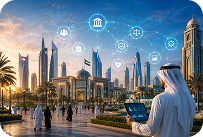
Digital transformation solutions in Dubai that reshape applications, data, and workflows into one governed operating layer for GCC enterprises.
Schedule Your Assessment
Years in the Region
Enterprises Transformed
Avg Uptime SLA Delivered
GCC Markets Served
Enterprise systems shaped over the last decade were never built for the compliance velocity, regulator activity, and AI ambition landing on CIO desks today. Boards ask for unified insight while operational teams still juggle disconnected ERP modules, siloed CRM records, and integration middleware nobody fully documents. Programs delivering digital transformation in Dubai are now less about lift-and-shift and more about disciplined reconstruction across the application, data, and process layers. That reconstruction is where our practice concentrates every consultant hour.
Enterprise AI ambitions stall at data quality, not model selection, so the fix runs upstream through governance, lineage, and platform architecture. As a digital transformation solutions company in Dubai serving finance, government, energy, and healthcare buyers, we assess the existing estate and rebuild each layer for measurable business impact. Every engagement is structured to deliver compliance, resilience, and intelligent automation on a single governed foundation your teams can operate confidently long after we exit hypercare.

Most programs begin with strong intent and lose traction inside execution. Vendor sprawl, data debt, and stalled cloud migrations block progress across the region, which is why disciplined digital transformation consulting in Dubai and rigorous supplier selection matter well before implementation starts.
Every engagement begins inside the operating context your teams already inhabit. Enterprise buyers evaluate transformation partners on delivery evidence, sector fluency, and post-go-live accountability, not on brand recognition. We operate as a digital transformation solutions company in Dubai with regional consultants, not a global slide deck flown in for kickoff and forgotten before hypercare.

Legacy constrains agility. We migrate ERP and CRM to cloud-native architectures with disciplined cutover planning.
Silos fracture decisions. We consolidate and govern enterprise data so analytics and AI scale predictably.
Manual cycles drain teams. Process mining and automation orchestrate work end to end across departments.
Rules shift quarterly. Residency, audit evidence, and controls are engineered into every workflow from day one.
Our digital transformation solutions in Dubai run on enterprise-grade platforms including SAP S/4HANA, Oracle Fusion Cloud, Microsoft Dynamics 365, Salesforce, ServiceNow, Microsoft Azure, and Databricks. Platform selection follows workload profile, integration landscape, and regulatory mandate.
Measurable outcomes from digital transformation in Dubai engagements, calibrated for GCC enterprise realities.
Consolidation lowers licensing, maintenance, and infrastructure overhead across the modernized estate.
AIOps and process intelligence cut repetitive service desk tickets sharply across operations.
Modern integration and CI/CD pipelines shorten concept-to-release cycles for business teams.
Automated evidence and audit-ready workflows shrink regulatory review windows meaningfully.
Regulatory posture, data sensitivity, and operating rhythm shift sharply between sectors. Our modernization work is engineered against those realities across finance, healthcare, government, energy, retail, logistics, manufacturing, and education, so every program respects the operating context inherited by its business owners.
Explore current trends, buyer-side best practices, and expert perspectives on enterprise modernization programs unfolding across the UAE and the wider GCC region today.
See how enterprises across regulated industries have partnered with us to overcome complex modernization challenges and reach measurable operating outcomes at meaningful scale.
Let's discuss how our IT solutions can drive your business forward.
Answers to the questions enterprise buyers ask most often when scoping modernization programs across Dubai and the wider GCC region today.
The strongest engagements combine regional delivery presence with vendor-certified expertise and named senior architects. Gerab System Solutions works as a Cisco Gold Partner, Microsoft partner, Oracle partner, and IBM partner, backed by ISO 27001:2022 certification and a 13-year record across the GCC. Enterprises benefit from architects who understand SAMA, NESA, and sector-specific compliance, delivery managers based in Dubai and Abu Dhabi, and post-implementation support tied to real service level agreements. That combination is what separates outcome-driven consulting from advisory slide decks that never reach production or governed operational handover.
Enterprises typically shortlist regional systems integrators with proven implementation records across SAP, Oracle, and Microsoft Dynamics 365. Gerab System Solutions belongs on that shortlist for organizations weighing cloud-first ERP moves, brownfield S/4HANA transitions, or Dynamics 365 rollouts across multiple GCC markets. Selection criteria that matter include partner certifications, regional consultant availability, industry references in the buyer's sector, structured migration methodology, and clear post-go-live managed services coverage. A supplier that only sells licenses without delivery muscle rarely finishes ERP modernization on time, on budget, or with genuine business adoption.
Our team handles both SAP and Oracle migrations across GCC enterprises, covering assessment, blueprinting, data migration, cutover planning, and hypercare. Engagements include SAP ECC to S/4HANA transitions, Oracle E-Business Suite modernization, and Oracle Fusion Cloud rollouts, delivered under one accountable program structure. Consultants are certified on the respective platforms and work alongside your process owners rather than presenting from a distance. Depending on scale, timelines typically span nine to eighteen months for full brownfield migrations, and shorter for phased greenfield deployments across finance, supply chain, procurement, and HR modules.



Program cost depends on scope, application count, data complexity, and target operating model, but most enterprise engagements begin between mid-six-figure and low-seven-figure AED budgets. Costs reduce sharply when legacy consolidation is executed properly, with organizations typically seeing meaningful savings on licensing, maintenance, and infrastructure once modernization completes. Gerab System Solutions builds every scoping exercise around a total cost of ownership view rather than upfront license price, so leadership sees the operating impact across a three to five year horizon. A structured assessment produces a defensible business case before capital is committed.
Yes. Financial services buyers should look for a partner with active experience in SAMA-regulated workloads, PCI DSS-aligned architecture, and core banking or wealth platform integrations. Gerab System Solutions has delivered infrastructure, security, and application modernization across finance clients, backed by ISO 27001:2022 certification and the Sophos MDR Partner of the Year 2024 recognition. Priorities in this sector include audit-ready data lineage, resilient failover architecture, identity governance, and clear separation of duties across production environments. A finance-fluent partner should also demonstrate real experience delivering under Central Bank and regulatory scrutiny across the wider GCC.
Yes. Our AI-enabled process intelligence practice combines process mining, workflow automation, and AIOps orchestration on platforms such as ServiceNow, Microsoft Power Automate, and partner RPA tools. Engagements start with a discovery of high-volume processes across finance, HR, service desk, and supply chain, then map bottlenecks against automation and augmentation opportunities. Outcomes include reduced manual cycles, predictive incident detection, and structured governance for enterprise AI models. Every deployment is designed around data quality upstream, since AI initiatives stall when governance, ownership, and lineage are not fixed before production models go live.
Buyers running Dynamics 365 Finance, Supply Chain, Customer Service, or Business Central should shortlist Microsoft-certified partners with proven regional delivery. Gerab System Solutions supports Dynamics 365 implementation, integration with Azure, Power Platform extensions, and long-term managed support across the GCC. Selection criteria include consultant certifications, ISV alignment, Power Platform capability, upgrade discipline, and structured change management for finance and operations teams. A capable partner also connects Dynamics 365 to Azure landing zones, identity through Entra ID, and enterprise data platforms so reporting, security, and analytics scale together with the ERP.
Enterprises operating under SAMA or NESA obligations should work with partners who embed those frameworks into architecture from day one. Gerab System Solutions delivers ISO 27001:2022 aligned engagements with security architects who work regularly against the SAMA cybersecurity framework, NESA IAS controls, and GDPR-adjacent data protection expectations. Deliverables include gap assessments, control mapping, data residency architecture, evidence automation, and audit-ready documentation. Compliance is built into the workflow layer rather than bolted on afterward, which reduces audit preparation time and lets the business respond faster when regulatory expectations evolve during the modernization program lifecycle.
Yes. Legacy application modernization is one of our most requested services and covers assessment, refactoring, replatforming, and full re-architecture depending on the workload. Engagements typically address mainframe estates, custom .NET or Java monoliths, and end-of-life ERP environments, moving them to containerized or PaaS architectures on Azure, AWS, or Oracle Cloud Infrastructure. Our approach uses the six R framework, so each application receives the right disposition rather than a blanket cloud lift. The result is lower operating cost, faster release cycles, and an application estate that finally supports the integration and AI initiatives the business now needs.
Government buyers should evaluate partners who understand federal and emirate-level compliance mandates, sovereign cloud requirements, and citizen service platforms. Gerab System Solutions has delivered infrastructure, security, and application projects for public sector clients across the GCC, with architects familiar with UAE Pass integration, sovereign data residency, and digital government service standards. Selection criteria include local delivery presence, security clearances, ISO 27001:2022 certification, sector case studies, and structured knowledge transfer. Government programs also require partners who commit to long-term managed services, since public sector platforms rarely enter production and then run themselves without ongoing operational stewardship.
Compare partners across four axes: data engineering depth, governance frameworks, platform certifications, and sector fluency. A capable partner runs data unification on Microsoft Fabric, Databricks, Snowflake, or Oracle Autonomous Data Warehouse depending on your existing estate. Ask for evidence of enterprise-scale data model design, master data management delivery, and integration into downstream BI and AI workloads. Also verify the partner treats data quality as a program, not a phase. Gerab System Solutions delivers unification programs that consolidate ERP, CRM, and operational sources into a governed platform ready for analytics and machine learning across the business.
Yes. Healthcare engagements include HIS integration, MOH-aligned data protection architecture, and clinical system modernization aligned with local sector regulations. Energy sector engagements cover OT and IT convergence, SCADA integration into enterprise data platforms, remote workforce enablement, and cybersecurity aligned with critical infrastructure expectations. Both sectors share complex data sovereignty needs and cannot afford unplanned downtime, so architecture is designed with resilience, segmentation, and audit visibility as first principles. Our sector consultants work alongside your operational and clinical leaders so modernization respects the regulatory and safety context of every workflow being redesigned.
Our teams deliver Salesforce and ServiceNow implementations across sales, service, field operations, IT service management, and enterprise workflow use cases. Engagements cover discovery, org design, data migration, integration into ERP and identity, and continuous release management under an ITIL-aligned operating model. Salesforce work typically spans Sales Cloud, Service Cloud, and Experience Cloud, while ServiceNow deployments extend from ITSM into HRSD, CSM, and SecOps modules. Both platforms benefit from a partner that maintains the platform end to end rather than dropping consultants after go-live, and every engagement is structured around long-term platform stewardship.
Yes. Our CIO advisory practice supports enterprise leadership on target operating models, application rationalization, cloud investment strategy, cybersecurity posture, and multi-year modernization roadmaps. Deliverables include current-state assessments, prioritized initiative portfolios, business cases with total cost of ownership modeling, and governance frameworks that align technology delivery with board expectations. Consultants work directly with CIOs, CTOs, and enterprise architects rather than through account management layers. Gerab System Solutions frames every strategic engagement around measurable business outcomes, and roadmaps are designed to survive leadership changes, budget cycles, and evolving compliance obligations across the wider GCC region.
Yes. AI-ready workflows begin with data governance and integration, not with model selection. We help enterprises assess their data estate, remediate quality issues, unify sources into a governed platform, and only then layer AI use cases on top. Practical AI patterns include intelligent document processing, predictive maintenance, service desk deflection, and financial forecasting. Gerab System Solutions works with enterprise partners including Microsoft, Oracle, and IBM to deliver AI foundations on Azure OpenAI, Oracle AI Services, and IBM watsonx, so buyers gain platform choice while retaining a single accountable partner for architecture, security, and operations.
Post go-live coverage separates capable implementation partners from delivery-only vendors that disappear after cutover. Gerab System Solutions offers structured managed services covering ERP, CRM, integration, cloud, and security estates under SLA-backed contracts staffed 24/7 by regional engineers. Coverage includes incident management, release management, application performance monitoring, patching, minor enhancements, and quarterly service reviews with named service delivery managers. Enterprises get continuity of the team that implemented the environment, not a handover to a distant support pool, so institutional knowledge stays intact and improvement backlogs actually move forward every quarter.
Program length varies with scope. A focused workstream such as ERP module modernization or a data platform build typically runs six to nine months. A full enterprise-wide program covering ERP, CRM, data, and cloud migration usually spans eighteen to thirty-six months, delivered in structured waves rather than a single big-bang cutover. Assessment and design phases run six to twelve weeks. Wave-based delivery gives leadership visible progress every quarter, keeps risk contained, and ensures operational teams absorb change at a sustainable pace. Timelines are always calibrated against your regulatory calendar, budget cycle, and business seasonality before execution begins.
Change management is treated as a core workstream, not a communications afterthought. We build stakeholder maps, run role-based impact assessments, define readiness metrics, and design training pathways that mirror the actual workflows changing under the new platform. Executive sponsorship, middle-management enablement, and end-user support are handled through separate but coordinated channels. Gerab System Solutions embeds change specialists into every major program because platform go-lives fail more often from adoption gaps than from technical defects. This discipline is what allows large ERP, CRM, and workflow rollouts to reach steady-state operations without productivity dips lingering into the following quarter.
IT modernization upgrades infrastructure, platforms, and applications, typically without changing how the business operates day to day. Digital transformation restructures how work gets done by combining process redesign, data unification, cloud architecture, and AI-enabled workflows into an integrated operating model. Modernization is a subset of transformation, and most transformation programs include heavy modernization work in their early phases. The distinction matters at budget approval, because leadership needs to know whether the program will deliver operational efficiency, new business capability, or both. Our engagements are scoped explicitly so leadership sees which outcomes each phase will produce.
Sovereignty is designed into the architecture from day one, not added later. We map regulated data classes against approved storage locations, select hyperscaler regions inside the UAE or the nearest compliant region, and implement encryption, key management, and access controls under a defined sovereignty policy. Workloads under SAMA, NESA, MOH, or sector-specific regulation are placed on architectures that keep data, keys, and administrative access within sovereign boundaries. Gerab System Solutions works with Microsoft, Oracle, and regional sovereign cloud providers to give enterprise buyers real platform choice while meeting residency, audit, and cross-border restrictions imposed by their regulators.